Wedding Budget Breakdown: Where Your Money Actually Goes in 2026 (and How to Stretch Every Dollar)
If you have recently analyzed the raw data for 2026 wedding costs, the numbers demand immediate attention. As of May 11, 2026, most U.S. couples are spending a significant sum on their events, with national averages holding steady between $34,000 and $36,000. However, the median cost sits closer to $18,000. This massive variance reveals a fundamental truth about event planning: the final price tag is rarely about the average. It is about strategic resource allocation.
Planning a large-scale event is an exercise in managing uncertainty. Couples routinely sign five-figure contracts for spaces and floral arrangements based entirely on generic inspiration photos. This disconnect creates profound visualization anxiety. You need a system to validate your design choices before you spend a single dollar on non-refundable deposits.
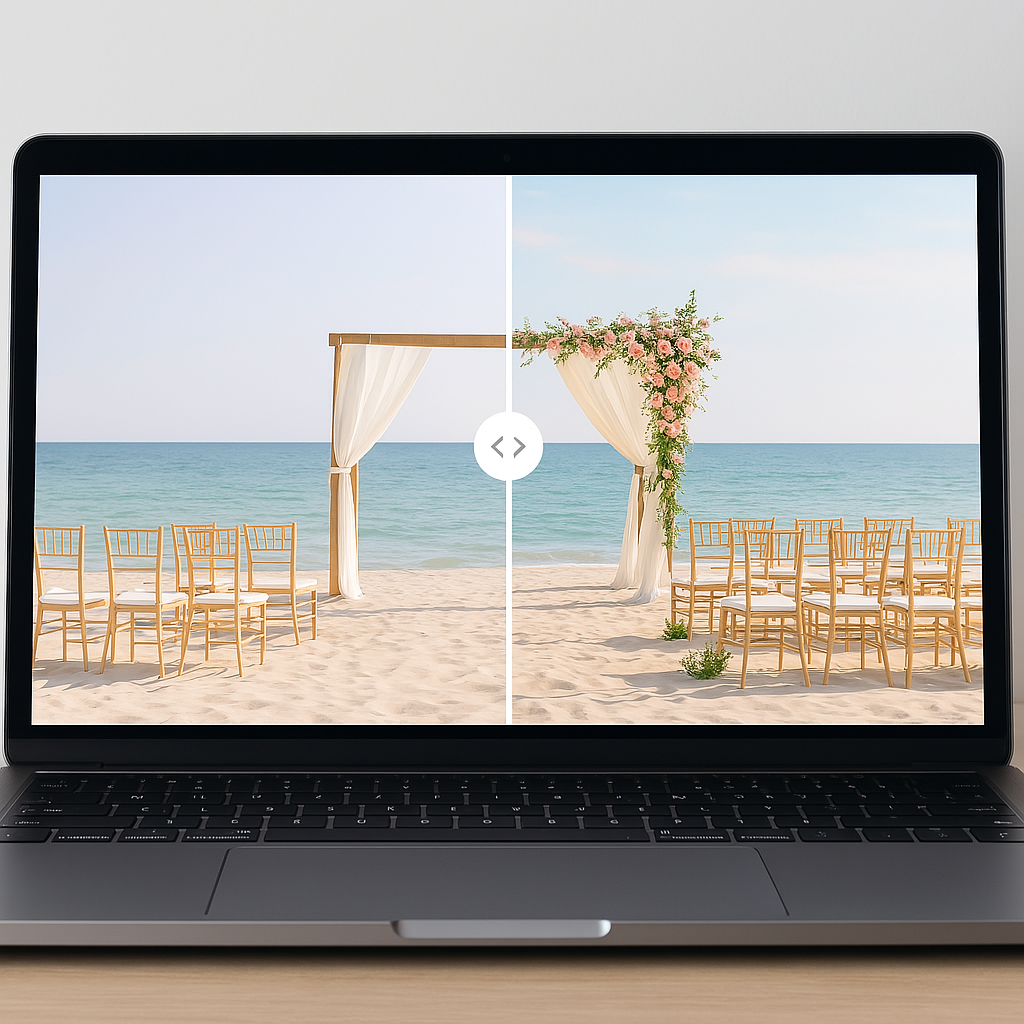
This is exactly where VenuePreview becomes an essential part of your planning stack. By leveraging our AI-powered visualization tools, you can see your venue as it will look fully decorated, eliminating the financial risk of blind aesthetic decisions. The key to a successful event is not hitting an arbitrary budget number. The key is knowing precisely where your money goes and building visual confidence in every choice.
Big Picture: The Reality of Wedding Spending in 2026
To optimize your spend, you must first understand the baseline. Across recent industry data, including reports from platforms like Zola and The Knot, a standard U.S. wedding of approximately 100 guests follows a highly predictable distribution curve.
Here is the typical category allocation for 2026:
| Category | Typical % of Budget | 2026 Average Cost |
|---|---|---|
| Venue & Site Fees | 20 to 25% | $8,500 |
| Catering (food) | 18 to 22% | $6,900 |
| Bar / Drinks | 10 to 15% | $5,500 |
| Photography | 10 to 12% | $4,400 |
| Videography | 8 to 10% | $4,000 |
| Planning / Coordination | 8 to 10% | $4,000 |
| Flowers & Décor | 10 to 15% | $6,300 |
| Music & Entertainment | 5 to 7% | $1,600 |
| Attire (dress, suit, etc.) | 6 to 10% | $2,800 |
| Beauty (hair & makeup) | 2 to 4% | $1,000 |
| Cake & Desserts | 2 to 3% | $900 |
| Stationery | 1 to 3% | $500 |
| Officiant / Ceremony Fees | 1 to 2% | $300 to $500 |
| Misc / Tips / Extras | 5 to 10% | Varies |
When analyzing this data, two structural realities stand out. First, your venue, catering, and bar will consume 50 to 60 percent of your total budget. Decisions made in these three categories dictate the financial boundaries for the rest of your event. Second, flowers and décor represent a massive capital outlay. Because aesthetic preferences vary wildly, couples frequently miscalculate this expense.
Step 1: Establish Your Guest Count Limit
Every effective budget begins with a hard limit on attendance. The guest list is not just a headcount. It is a cost multiplier. In 2026, the average cost per guest has risen to $292. Every incremental addition to your list triggers compounding expenses across catering, beverages, seating rentals, and centerpieces.
A practical framework used by top coordinators is the $200 to $350 per-person rule. This estimates the baseline cost for a traditional dinner and dancing reception in most U.S. markets. If your maximum comfortable spend is $25,000, hosting 125 people requires aggressive cost-cutting in high-leverage areas like photography or design.
Data consistently shows that couples report the highest satisfaction levels when hosting between 40 and 80 guests. This tier maintains an intimate atmosphere while unlocking the budget to invest in premium vendor talent and bespoke design elements.
Average 2026 Wedding Budget by Tier
Averages obscure reality. To understand market dynamics, we must segment the data into distinct spending tiers. Your goal is to align your total spend with the specific experience you want to engineer.
| Budget Tier | Typical Total Spend | Strategic Profile |
|---|---|---|
| $0 to $15,000 | $8,000 to $15,000 | Elopements, micro weddings (under 30 guests), heavy DIY execution, non-traditional venues. |
| $15,001 to $40,000 | $20,000 to $35,000 | The traditional mid-size U.S. wedding. 75 to 120 guests with a full professional vendor team and calculated trade-offs. |
| $40,000+ | $45,000 to $80,000+ | Premium urban venues, large capacities, comprehensive planner coordination, custom architectural décor. |
Funding sources drastically alter these tiers. In 2026, couples who self-fund their weddings spend approximately 23 percent less than those receiving significant family contributions. Regardless of your tier, success comes from disciplined allocation rather than sheer capital volume.
Category-by-Category Wedding Budget Breakdown for 2026
Let us deconstruct each major line item. Understanding the underlying cost drivers in these categories gives you the leverage to negotiate effectively and trim excess waste.
1. Venue and Site Fees (20 to 25%)
The national average for a venue is $8,573, though major platforms report the average venue cost at $12,900 when factoring in upper-quartile spending. This fee secures time, exclusivity, and critical infrastructure like climate control and commercial kitchens.
Regional variation here is extreme. A prime urban location in New York City commands a premium of $10,000 or more compared to a suburban equivalent. To create structural savings, consider off-peak timing. Friday evenings or Sunday brunches routinely offer 20 to 40 percent discounts on the exact same real estate.
Many couples fear an empty industrial space or blank-slate hall will feel underwhelming. They compensate by over-indexing on expensive rentals. You can mitigate this risk entirely. By uploading a few photos of an empty space to our platform, you can visualize your wedding before you spend heavily on filler décor. This confirms whether a venue requires a $5,000 floral installation or just strategic uplighting to look stunning.
2. Catering and Food Services (18 to 22%)
Food costs average $6,900 nationally. This category scales aggressively based on service style and ingredient selection. Plated dinners require complex logistics and expanded serving staff, pushing costs to $100 or $150 per person.
The most effective optimization lever here is the service model. Transitioning from a plated multi-course meal to an elegant buffet or family-style service reduces labor overhead. This shift alone can generate a 20 to 30 percent reduction in catering costs, saving thousands of dollars for a 100-guest event.
3. Bar Service (10 to 15%)
Bar service averages $5,500. You are paying for alcohol, specialized labor, glassware, ice, and mandatory liability insurance. A full open bar is the standard expectation, but it is also the most volatile budget item.
You can contain this volatility through a limited bar strategy. Offering beer, wine, and two curated signature cocktails reduces your beverage spend by up to 35 percent. Alternatively, you can run a full open bar during cocktail hour and transition to a limited menu after dinner.
4. Photography and Videography (18 to 22%)
These two categories represent the only appreciating assets from your event. Photography averages $4,400, while professional videography adds another $4,000. Combined, visual media captures 18 to 22 percent of your resources.
The pricing hierarchy is strictly tied to experience. Newer professionals charge between $1,200 and $3,000, while established full-time talent commands $5,000 to $10,000. To optimize this category, prioritize hours of coverage over physical deliverables. Book an elite photographer for six highly focused hours rather than a mediocre one for twelve hours. You can always purchase physical albums years later.
5. Wedding Planning and Coordination (8 to 10%)
Full-service planning averages $4,047, while month-of coordination typically costs between $800 and $3,000. Planners provide immense ROI by utilizing established vendor networks to secure better pricing and shielding you from logistical friction.
If full-service planning exceeds your parameters, month-of coordination is a non-negotiable asset. A professional coordinator ensures your design vision is executed precisely, allowing you to actually experience the event you funded.
6. Flowers and Décor (10 to 15%)
This category requires rigorous oversight. The average flowers and décor cost is $6,345, but Pinterest-driven expectations frequently push this number past $10,000. Floral installations, custom signage, and upgraded linens scale exponentially.
The most common mistake is attempting to decorate every square foot of a venue. Strategic design dictates concentrating capital on high-impact zones like the ceremony backdrop and the head table. You can also generate massive savings by prioritizing in-season, locally sourced blooms over imported varieties.
Design clarity is your ultimate cost-saving tool. VenuePreview was engineered specifically for this phase. Instead of approving expensive vendor quotes based on guesswork, you can generate photorealistic images of your exact venue fully decorated. This empowers you to communicate your precise vision to florists, eliminating rounds of costly trial and error.
7. Music and Entertainment (5 to 7%)
Entertainment averages $1,600, but the modality drives the final number. An experienced DJ typically costs between $1,500 and $3,000. A live band averages $4,500, with premium ensembles scaling past $7,000 due to the required sound technicians and stage crew.
If live music is a priority but the budget is constrained, consider a hybrid approach. Hire a string quartet or acoustic duo for the ceremony and cocktail hour, then transition to a professional DJ for the reception.
8. Attire and Beauty (8 to 14%)
The national average for a new retail wedding dress is $2,000, with alterations adding an additional $550. Suit or tuxedo purchases range from $500 to $1,500, while rentals offer a highly efficient $150 to $300 alternative.
Bridal beauty services typically average $300 for the bride, with wedding party services costing around $200 per person. To optimize attire costs, explore sample sales or off-the-rack designer options, which routinely reduce gown expenditures by 50 percent.
9. Cake and Desserts (2 to 3%)
The traditional tiered wedding cake averages $540. Pricing is dictated by design complexity rather than sheer volume. Intricate fondant work, sugar flowers, and gold leaf applications demand specialized labor that drives up the per-slice cost.
A highly effective tactic is the display cake strategy. Commission a beautifully designed, smaller cake for the official cutting ceremony, and serve your guests from highly cost-efficient sheet cakes prepared in the kitchen.
10. Stationery, Officiant, and Miscellaneous (5 to 10%)
Printed invitation suites average $500, while an experienced officiant will cost roughly $300. However, the true danger in this category lies in the miscellaneous hidden fees.
You must maintain a strict 5 to 10 percent contingency buffer. This capital absorbs unexpected rental delivery fees, mandatory venue insurance, day-of transportation, and standard vendor gratuities. Operating without a contingency buffer guarantees budget overruns.
Sample 2026 Wedding Budgets by Total Spend
Frameworks are only useful when applied to real numbers. Below are three calibrated budget models based on 2026 market dynamics.
Example 1: $20,000 Wedding Budget (60 to 80 Guests)
| Category | % | Approx. Amount |
|---|---|---|
| Venue & Site Fees | 22% | $4,400 |
| Catering (Food) | 18% | $3,600 |
| Bar / Drinks | 10% | $2,000 |
| Photography | 10% | $2,000 |
| Videography | 5% | $1,000 |
| Flowers & Décor | 10% | $2,000 |
| Planning / Coordination | 6% | $1,200 |
| Music & Entertainment | 6% | $1,200 |
| Attire & Beauty | 7% | $1,400 |
| Cake & Desserts | 2% | $400 |
| Stationery & Officiant | 2% | $400 |
| Misc & Buffer | 2% | $400 |
At this scale, strict guest list curation is mandatory. Focus on non-traditional venues or Friday dates to suppress rental fees. To maximize your $2,000 décor allocation, use our $19 Basic package to test targeted aesthetic upgrades. Seeing the output allows you to deploy every dollar where it has the highest visual impact.
Example 2: $35,000 Wedding Budget (100 to 130 Guests)
| Category | % | Approx. Amount |
|---|---|---|
| Venue & Site Fees | 23% | $8,050 |
| Catering (Food) | 20% | $7,000 |
| Bar / Drinks | 12% | $4,200 |
| Photography | 11% | $3,850 |
| Videography | 8% | $2,800 |
| Planning / Coordination | 7% | $2,450 |
| Flowers & Décor | 10% | $3,500 |
| Music & Entertainment | 4% | $1,400 |
| Attire & Beauty | 3% | $1,050 |
| Cake & Desserts | 2% | $700 |
| Stationery & Officiant | 2% | $700 |
| Misc & Buffer | 2% | $700 |
This represents the national median experience. The expanded capital allows for a refined venue and elevated catering. With a $3,500 floral budget, you have room for select custom installations. At this tier, our $29 Premium package becomes highly strategic. It delivers 100 visualizations across five style variations and includes priority vendor sharing tools. You can effortlessly compare venue styles and align your entire team around a unified design document.
Example 3: $60,000 Wedding Budget (150 to 200 Guests)
| Category | % | Approx. Amount |
|---|---|---|
| Venue & Site Fees | 24% | $14,400 |
| Catering (Food) | 21% | $12,600 |
| Bar / Drinks | 13% | $7,800 |
| Photography | 9% | $5,400 |
| Videography | 7% | $4,200 |
| Planning / Coordination | 8% | $4,800 |
| Flowers & Décor | 10% | $6,000 |
| Music & Entertainment | 4% | $2,400 |
| Attire & Beauty | 2% | $1,200 |
| Cake & Desserts | 1% | $600 |
| Stationery & Officiant | 1% | $600 |
| Misc & Buffer | 1% | $1,000 |
Complexity scales alongside budget. A $60,000 spend requires rigorous project management. You are now contracting custom lighting, complex floral rigging, and bespoke furniture rentals. Visual alignment is no longer optional.
Our $49 Luxury package is designed for this exact scenario. It generates 200 photorealistic variations across 10 distinct styles and includes priority support. Providing this level of visual clarity to a premium design team prevents the friction and miscommunication that routinely plagues high-budget events.
How to Decide Your Own Budget Allocation
Do not copy a template blindly. Build a custom financial system using this five-step framework:
- Define the Ceiling: Establish the absolute maximum capital you are willing to deploy without compromising your post-wedding financial stability.
- Cap the Attendance: Run your total budget against the $250 per-person metric. If the math fails, reduce your guest count immediately.
- Isolate the Priorities: Select three categories that matter most to you. For some, it is the culinary experience and photography. For others, it is the venue architecture and the live band. Over-allocate capital here.
- Ruthlessly Cut the Rest: If a category is not in your top three, it must be optimized. Downgrade from a multi-tiered cake to a dessert bar. Skip the printed menus.
- Validate Before Execution: Never sign a design contract based on abstract concepts. Force visual clarity early in the timeline to prevent downstream change orders.
Where VenuePreview Fits Into Your 2026 Strategy
Data from 2026 shows that 60 percent of engaged couples cite aligning their budget with online inspiration as their primary planning stressor. Traditional physical staging or customized designer mockups cost between $500 and $2,000 in labor alone.
VenuePreview is the necessary technological bridge between raw inspiration and actual execution. We provide the visual proof required to make confident purchasing decisions.
The process is highly efficient. You upload one to three photos of an undecorated space. You select your preferred color palettes and structural styles. Within 10 to 25 minutes, our AI engine renders dozens of photorealistic scenes tailored to your exact location. This replaces anxiety with actionable data. Ready to lock in your design? Choose your package and start iterating immediately.
Moving from Financial Uncertainty to Visual Clarity
There is no objectively correct amount to spend on a wedding in 2026. A $15,000 intimate gathering can be executed with the same level of taste and precision as an $80,000 urban gala. The variable that determines success is not total funding. It is intentionality.
When you establish hard boundaries around your guest count, allocate capital based on personal priorities, and leverage modern tools to validate your design decisions, you eliminate the chaos of traditional planning. You stop guessing what your budget will yield and start engineering a predictable outcome.
Do not let poor visualization drain your resources. Take control of your design process today.
Related Posts
Ready to Visualize Your Wedding Venue?
See exactly how your venue will look on your wedding day with AI-powered visualizations. Get started in minutes with packages starting at just $19.