Decoding Wedding Venues: How to Narrow Down Your Options
The venue selection process is fundamentally broken for most engaged couples. In 2026, data shows that the average wedding costs $36,000. The venue decision represents the single largest financial commitment of that total. Yet, couples consistently approach this massive expenditure with incomplete information, ambiguous criteria, and an exhausting cycle of emotional second-guessing. They fall into a trap of decision fatigue that leaves them either paralyzed by infinite choices or locked into a space that ultimately fails to deliver on their design vision.
This complexity is driven by a profound visualization gap. Couples are inundated with highly styled imagery across social media and venue marketing materials. However, 85% of engaged couples report that inflation has affected their plans for the current 2026 season. This economic reality means you cannot simply throw endless budget at a venue to force it to match your Pinterest board. You need a systematic approach to venue selection that pairs practical constraints with visual proof.
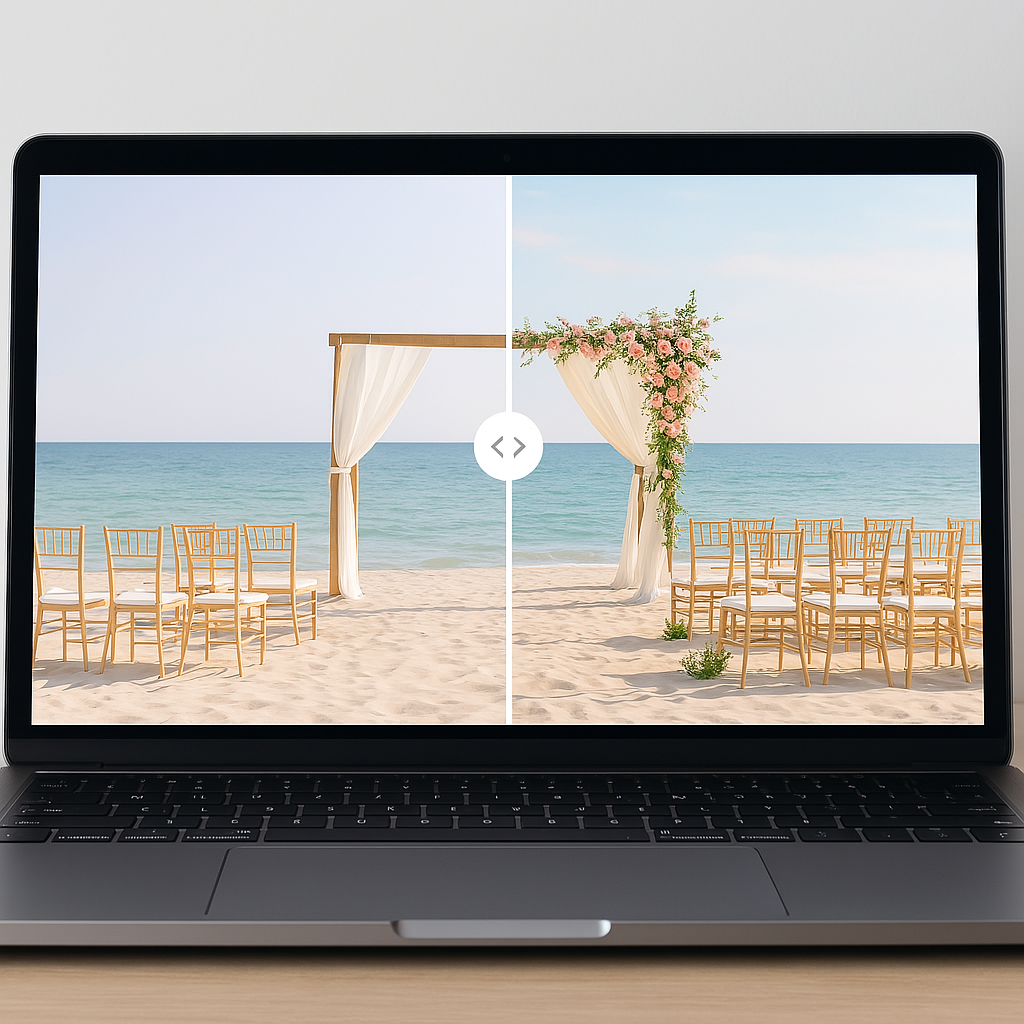
Venue selection does not have to be a gamble. By leveraging modern visualization technology, you can eliminate the guesswork entirely. Before you sign a contract or commit a single dollar to a deposit, VenuePreview allows you to see exactly how your wedding venue will look fully decorated. This guide will decode the venue selection process by breaking it down into a strict, data-informed framework that pairs operational realities with artificial intelligence.
Step 1: Define Your Non-Negotiables Before You Even Book a Tour
The most effective way to eliminate decision fatigue is to establish hard constraints before you begin your research. These non-negotiables act as automatic filters. They reduce your consideration set from hundreds of potential venues to a highly curated shortlist.
Guest Count and Capacity: Your Fastest Filter
Guest count is the primary input that dictates every other output in your wedding planning system. It determines your per-person budget, influences the logistical flow, and defines which venues are physically viable. Far too many couples start touring venues before locking down a realistic guest estimate.
You must differentiate between a venue's maximum capacity and its comfortable capacity. Venue sales teams will quote their absolute legal maximum limit. However, experienced planners note that comfortable capacity is usually 65 to 75 percent of that stated maximum. If you invite guests up to the absolute limit, your reception will lack room for a proper dance floor, lounge seating, or cocktail stations. Build your master list first and use that realistic number to instantly filter out venues that are too small or excessively large.
Overall Budget and Venue Cost Allocation
Understanding your budget requires moving beyond raw numbers and looking at strict percentage allocations. A proven framework is the 45 percent rule. Industry standards dictate that your venue, catering, and bar expenses should consume approximately 45% of the total wedding budget. When couples allow this allocation to creep past 55 or 60 percent, they inevitably face severe constraints regarding design, florals, and photography.
You must also account for the difference between the sticker price and the fully loaded cost. Base rental fees rarely represent your final invoice. Once you factor in mandatory service fees, rental delivery charges, local taxes, and required vendor premiums, couples routinely spend 20 percent more than they initially forecasted. Define your absolute maximum venue threshold based on the 45 percent rule before you allow yourself to fall in love with a property.
Location and Logistics for You and Your Guests
A venue cannot be evaluated on aesthetics alone. Its geographic location creates cascading logistical consequences for both your budget and your guest experience. You need to map out travel times, proximity to hotels, and available parking infrastructure.
A remote, picturesque location might photograph beautifully. However, it may require you to arrange expensive shuttle transportation for your guests and pay significant premium travel fees to your vendors. Furthermore, consider local municipal constraints like noise ordinances and strict curfews. Determine your ideal search radius and neighborhood preferences upfront to prevent logistical nightmares later.
Your High-Level Vision: Type of Setting and Vibe
Before opening a single browser tab, force yourselves to articulate your core aesthetic in two or three specific words. Categories like romantic garden, industrial chic, modern ballroom, or rustic barn serve as essential guardrails.
The baseline architecture of a venue heavily dictates your eventual decoration costs. If you want a warm, intimate atmosphere, booking a stark, concrete industrial loft will require massive financial investments in drapery, lighting, and plush rentals. Conversely, a highly ornate ballroom might clash violently with a minimalist modern vision. If you find yourself torn between entirely different aesthetics, you can explore different wedding aesthetics to understand how architectural foundations impact your ultimate design goals.
Step 2: Shortlist 5 to 8 Venues, Not 25
Once your constraints are defined, you transition from passive browsing to active filtering. The goal here is strict elimination. You want to narrow the field to a maximum of eight highly qualified targets.
How to Use Online Research Intentionally
Modern couples have massive databases at their disposal through platforms like The Knot and Zola. You must use these platforms surgically. Do not scroll endlessly through styled shoots. Instead, immediately apply your capacity and geographic filters.
Scan the remaining options strictly for base pricing, availability, and required vendor lists. Read consumer reviews specifically looking for systemic failures. Look for repeated mentions of poor communication, inflexible policies, or hidden fees. A single bad review is an outlier, but a pattern of vague contract terms is a massive red flag.
Filter by Deal-Breakers Up Front
Identify two to three absolute deal-breakers and aggressively cut venues that violate them. If you are determined to hire a specific external catering company, immediately discard any all-inclusive venue that mandates their in-house food program.
Other common deal-breakers include strict curfews, pet restrictions, or a lack of viable indoor backup spaces for inclement weather. Create a rigid must-have list. If a venue fails to meet even one of these critical requirements, remove it from your spreadsheet immediately. Emotional attachment to a venue that violates your core constraints will only cause friction later.
Trim the List with Photos and Visualization
Marketing photos are engineered to sell the venue, not to show you the reality of the space. To truly evaluate a property, you need to look past the heavy styling. Seek out photos of the empty rooms, or search for real weddings hosted there that match your exact guest count.
This is where you integrate AI tools into your workflow. If your search is currently entirely online, you can extract empty-room photos from venue websites and load them into VenuePreview. This allows you to generate completely decorated scenes based on your preferred style. You will quickly discover which spaces genuinely complement your vision and which ones simply rely on deceptive, expensive promotional styling.
Step 3: Create a Simple Comparison Scorecard for Your Top 3 to 5
To eliminate bias, you must quantify your options. A structured comparison scorecard forces you to evaluate venues across standardized metrics rather than relying on a vague gut feeling.
Core Categories to Compare
Build a simple spreadsheet and score your top venues from 1 to 5 across these critical dimensions:
- Look and Feel: Does the existing architecture support your vision, or will it require expensive cosmetic masking?
- Location and Accessibility: Is parking ample? Are hotels nearby? Is the space ADA compliant?
- Capacity and Layout: Can the space comfortably hold your cocktail hour and reception without awkward room flips?
- Budget Fit: Does the fully loaded estimate stay strictly within your 45 percent allocation?
- Restrictions: Are there strict noise curfews, vendor lock-ins, or rules against open flames?
- Amenities: Does the venue include high-quality tables, chairs, and getting-ready suites?
- Communication: Have they been prompt, transparent, and professional during your initial outreach?
How to Use the Scorecard to Narrow Down
Not all variables are equal. You must weight these categories based on your specific priorities. If a seamless guest experience is paramount, double the weight of the location and layout scores.
Run the numbers. Eliminate any venue that repeatedly scores low in your top two weighted categories. This quantitative approach removes the emotional noise and leaves you with the two or three most structurally sound options.
Visual Layer: Comparing Decor Potential Side-by-Side
Numbers validate the logic, but visuals validate the design. Take the top three venues from your scorecard and run a side-by-side comparative analysis.
Upload minimally decorated images from your finalists into your visualization tool. Apply the exact same aesthetic parameters to each space. Generate a moody fall concept or a crisp modern black-and-white look across all three venues simultaneously. Comparing these outputs side-by-side instantly reveals which venue naturally absorbs your aesthetic and which one fights against it.
Step 4: What to Actually Look For During Venue Tours
You should only step foot on a property once it has passed your strict quantitative filters. An in-person tour is not a casual browsing session. It is an operational audit.
First Impressions That Actually Matter
When you arrive, ignore the view for a moment and look at the operational reality. Check the state of the landscaping, the cleanliness of the restrooms, and the quality of the paint on the walls.
These micro-details signal the management team's overall level of operational excellence. A venue that neglects its baseboards and bathrooms will likely neglect critical details on your wedding day. Pay close attention to natural lighting at the time of your actual event, and listen carefully for disruptive ambient noise from nearby roads or commercial properties.
Layout and Guest Experience
Walk the exact path your guests will take. Note the proximity from the parking lot to the ceremony space. Evaluate the transition flow into the cocktail hour.
You need to identify bottlenecks. Is there enough room for a band, a packed dance floor, and your dinner tables without forcing guests to squeeze past each other? A space might look massive when empty, but once you insert 150 chairs, ten large round tables, and a catering team, the square footage disappears rapidly.
Questions to Ask the Venue Manager
Do not leave the tour without securing explicit, contractual answers to these operational variables:
- What are the precise rules regarding required, approved, or open vendors?
- What is the exact minute the music must stop, and what are the financial penalties for running over?
- Are there restrictions on hanging installations, open flames, or outside rental companies?
- Who is physically responsible for setup and teardown, and when do those teams gain access to the building?
- What is the explicit, guaranteed backup plan for extreme weather or power outages?
How to Capture the Right Photos for Later
Do not take stylized selfies or tight shots of pretty chandeliers. You need raw data. Stand in the corners of the room and take wide, landscape-oriented shots of the empty spaces.
Capture the odd corners, the ceiling heights, and the structural pillars. Stand exactly where your photographer will stand during the ceremony and shoot the backdrop. These raw, unedited wide shots are the perfect input parameters for your visualization tools later in the process.
Step 5: Visualize the Decor Before You Decide
You are now at the critical inflection point. You have the data, you have toured the finalists, and you have raw photos of the empty rooms. The final barrier is the visualization gap. Most couples simply guess at this stage. You will not.
Why Photos Alone Aren't Enough
Marketing photos represent someone else's wedding budget and someone else's design preferences. It is incredibly difficult for the human brain to mentally strip away heavy, rustic decor from a space and accurately replace it with a sleek, minimalist aesthetic.
If you rely solely on your imagination, you risk making profound miscalculations. You might assume a space needs a $5,000 floral installation to look complete, or conversely, you might underestimate how bare a massive ballroom will look with standard table settings.
Decoding Each Venue's True Potential
You need to apply rigorous visual testing. To learn how our platform works, the process is highly systematic. You take the 1 to 3 wide-angle photos you captured during your tour of the empty room.
You upload these inputs, select your precise style templates and color schemes, and let the AI models process the data. Within 10 to 25 minutes, you receive a massive output of photorealistic visualizations showing that exact room fully decorated. You are no longer guessing if a plain ballroom can handle a moody, modern aesthetic. You are looking directly at the proof.
Real Planning Wins from Visualization
This step creates immediate operational leverage. Visualization allows you to catch spatial design flaws before you sign contracts. You will instantly see if tall floral centerpieces clash with low, drop ceilings in a specific room.
More importantly, it optimizes your capital. You can clearly identify which rental items create massive visual impact and which ones fade into the background. When you hand these generated images to your florist or rental company, you bypass the friction of verbal miscommunication. You hand them an exact blueprint of your expectations.
Choosing the Right Visualization Strategy
You have granular control over how deep you want to take this analysis. When you are ready to review your visualization options, you can select the scale of your testing based on your remaining choices.
If you have isolated a single favorite venue and just want to validate your core style, you can generate 40 unique images across two distinct design variations. If you are actively comparing three different venues and need to see how they each handle various aesthetics, you can scale up to 100 images across five styles. For couples executing highly complex designs, you can extract up to 200 variations spanning ten distinct styles, complete with priority vendor sharing tools. The goal is to match the data output to your specific level of uncertainty.
Building Your Modern Wedding Toolkit
The final choice between two exceptional venues ultimately requires balancing hard data with your own intuition.
Cross-reference your generated visualizations against your scorecard. Confirm that the venue that looks the best in your renderings also passes your strict 45 percent budget allocation test. Ensure that the most beautiful space does not violate your non-negotiable logistical constraints regarding guest travel or curfews.
Once you have aligned your visual proof with your scorecard data, execute the 24-hour rule. Put the spreadsheets away. Close the image galleries. Give yourselves one full day to let the decision settle. If the data checks out and the visual proof gives you confidence, you are ready to sign the contract.
The era of planning weddings based on guesswork and blind hope is over. By defining strict parameters, filtering aggressively, utilizing analytical scorecards, and deploying advanced AI visualization tools, you eliminate the anxiety that plagues most couples.
You do not need to second-guess your choices when you have already seen the final result. Take control of your venue selection process today. Start Visualizing Your Venue right now and lock in your wedding decisions with absolute certainty.
Related Posts
Ready to Visualize Your Wedding Venue?
See exactly how your venue will look on your wedding day with AI-powered visualizations. Get started in minutes with packages starting at just $19.