Navigating Wedding Venues: How Many Should You Consider Before Deciding in 2026?
Your wedding venue dictates every downstream decision you make. It determines your guest count constraints, establishes your aesthetic boundaries, and consumes a massive portion of your total budget allocation. Because of this high leverage, engaged couples face a severe case of decision paralysis during the venue hunting phase.
The most common question that surfaces in 2026 planning communities is a search for a specific benchmark. Exactly how many wedding venues should you consider before deciding? Look at too few spaces, and you fear you are settling. Look at too many, and you succumb to decision fatigue where every ballroom, barn, and garden begins to blur into a singular, overwhelming anxiety.
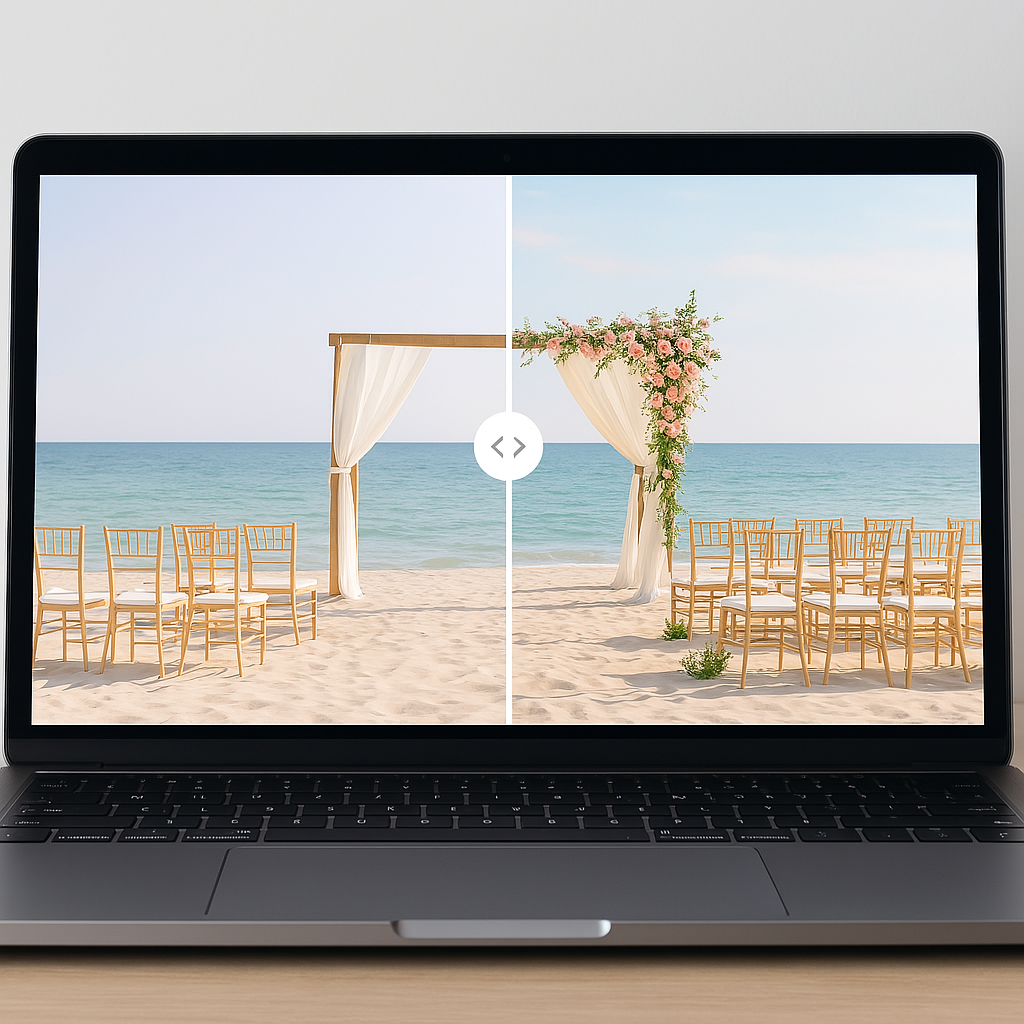
The core friction point in this process is a lack of visual fidelity. The traditional approach requires couples to tour empty rooms and mentally project a $30,000 design concept onto a blank canvas. This creates a massive visualization gap. Instead of relying on imagination, you can discover how you can solve venue visualization anxiety with VenuePreview. Our AI-powered platform turns simple photos of empty spaces into fully decorated, photorealistic renderings in minutes.
By applying a structured framework to your venue search, you can identify the exact number of spaces you need to evaluate. This guide will break down the venue selection funnel, provide a system for ruthless prioritization, and show you how to lock in your decision with absolute confidence.
The Venue Selection Funnel: Defining "Enough"
When evaluating complex decisions, it helps to look at aggregate data to establish a baseline funnel. The venue search is not a random walk. It is a structured process of elimination.
Data from a 2024 industry analysis reveals a clear funnel for successful venue selection. Most engaged couples research approximately 10 to 20 venues online at the top of the funnel. From there, they request detailed quotes from five to ten properties. They eventually tour two to five venues in person. Finally, they narrow their serious consideration down to one to three final contenders before signing a contract.
This is a proven range, not a rigid mandate. Your specific position within this range depends on three critical variables:
- Geographic and Temporal Flexibility: If you are bound to a specific date or a highly constrained geographic area, your viable options shrink immediately. You might only have three realistic contenders in your entire city. In this case, touring two venues is completely sufficient.
- Decision-Making Typology: Behavioral economics divides people into "maximizers" and "satisficers". Maximizers feel compelled to analyze every available option to ensure maximum utility. Satisficers establish criteria and execute a decision the moment a venue meets those benchmarks.
- Aesthetic Specificity: If you require a highly specific aesthetic, your initial research phase must be broader, but your tour phase will be shorter. The venues either meet your rigid visual criteria or they fail immediately.
Step 1: Top of Funnel Online Research
Before you look at a single venue gallery, you must establish your non-negotiables. Entering the venue search without hard constraints is a recipe for endless scrolling and emotional decision-making.
Establishing Your Non-Negotiables
Create a clarity document with your partner. This document acts as your primary filter. Any venue that fails a non-negotiable is immediately disqualified from your pipeline. Your list must include quantitative realities.
Define your strict guest count range. A venue that "fits up to 150" will feel vastly different than one built specifically for an intimate 75-person gathering. Next, map out your budget constraints. Industry averages dictate that many couples allocate thirty percent of their budget to the venue and catering, but your specific financial model must govern this choice.
Identify your must-have qualitative requirements. Do you require outside catering for cultural reasons? Are there strict accessibility requirements for elderly family members? Do you need a venue without strict noise ordinances for a late-night reception? Document these constraints clearly.
Leveraging Aggregators and Platforms
Once your constraints are documented, move to the discovery phase. Major wedding directories provide excellent top-of-funnel aggregation. Start your search on The Knot and Zola to understand the landscape of your local market. Use specialized platforms like Here Comes The Guide to find venues categorized by specific architectural styles or amenities.
While these platforms are powerful, they present a curated, stylized version of the truth. Venue galleries typically display their spaces styled to someone else's taste or completely empty. They rarely reflect your specific aesthetic. This is where you must filter ruthlessly. If a venue cannot meet a non-negotiable, do not add it to your list "just to see."
Step 2: Narrowing to a Short List of Contenders
Your goal at this stage is to shrink your list from twenty possibilities to a highly qualified list of five to ten venues. This requires moving from passive browsing to active data collection.
The Quote Request Protocol
Draft a standardized inquiry template to send to your narrowed list. You are testing for two things: pricing viability and communication velocity. A venue that takes two weeks to reply to a sales inquiry will be a nightmare to coordinate with during actual planning.
Ask for specific data points:
- Date availability or flexible date options.
- True capacity for a seated dinner versus a cocktail setup.
- Starting rental fee and hidden minimum spend requirements.
- An itemized list of included inventory like tables, chairs, and linens.
- Strict vendor restrictions or exclusivity clauses.
Building the Comparison Matrix
As the data returns, map it into a centralized comparison spreadsheet. This removes emotion from the initial screening process. Eliminate venues that demand minimums beyond your budget cap. Cut venues that force you into catering options you dislike.
You will likely be left with a solid cohort of five to eight venues. These spaces fit the math. They have the right dates. They are professionally responsive. They have survived the objective filter. Now, it is time to evaluate the physical space.
Step 3: Optimizing Your Tour Strategy
You should aim to tour between two and five venues. Touring more than five properties in person introduces severe decision fatigue. After the fifth tour, architectural details blur, floor plans become confusing, and you lose the ability to evaluate spaces critically.
When 2 to 3 Tours are Sufficient
You can confidently limit your search to two or three tours if your top candidates represent distinctly different categories. Touring one industrial loft, one historic estate, and one modern hotel allows you to test entirely different hypotheses about your wedding day. If one of these clearly aligns with your vision and budget, there is zero strategic value in touring three more lofts just to validate your choice.
The Visualization Checkpoint
If you feel compelled to schedule a sixth or seventh tour because nothing feels quite right, pause. The problem is rarely the venues themselves. The problem is usually a failure of imagination.
You are standing in a raw space, struggling to visualize a $20,000 floral installation and custom lighting setup. Before booking more tours, you need to see your venue as it will look in reality. Taking reference photos from your top three choices and processing them through our visualization engine allows you to compare actual design outcomes, saving you days of pointless travel.
What to Actually Evaluate During a Venue Tour
A venue tour is not a casual walkthrough. It is an operational site visit. You must look past the complimentary champagne and the sales pitch to evaluate the space as functional infrastructure.
Auditing Logistics and Flow
Test the venue from the perspective of your most demanding guest. Where is the arrival point? Evaluate the friction between the ceremony space and the cocktail area. If your wedding requires "flipping" a room from ceremony to reception, investigate where guests will be held during this transition.
Verify the less glamorous necessities. Count the bathrooms relative to your guest list. Check the accessibility of elevators. Look at the catering prep area. If the kitchen infrastructure is inadequate, your food quality will suffer regardless of who you hire.
For outdoor venues, interrogate the weather contingency plan mercilessly. A tent is not a backup plan if the ground floods. Ask to see exactly where a 150-person dinner will be relocated if a thunderstorm hits. If the backup space feels like a punishment, that venue requires serious reconsideration.
Assessing Design Constraints
Observe the fixed architectural constraints. Note the ceiling heights, the placement of permanent fixtures, and the existing light sources. A dark, wood-paneled country club cannot be transformed into a bright, airy, modern space without an astronomical drapery and lighting budget.
Ask the venue coordinator to show you photos of different layout configurations. Pay attention to how natural light moves through the space at the specific time your ceremony will occur. These structural realities matter far more than the temporary decor the venue might have set up that day.
How to Know When You Have Found "The One"
Identifying the winning venue requires synthesizing objective data with subjective resonance. You cannot rely purely on spreadsheets, nor can you rely entirely on a gut feeling. You need both to cross the finish line.
The Objective Alignment
You can safely stop searching when a venue clears these specific hurdles:
- The pricing is transparent and fits comfortably within your allocated budget.
- The floor plan handles your guest count without requiring complex logistical workarounds.
- The venue operates with professional, responsive management.
- The backup weather plan is something you could genuinely live with.
If a venue checks these boxes, it is a highly viable candidate. The final step is determining if it is the right stylistic container for your event.
The Visualization Test
Most couples report a specific feeling when they find the right venue. They find themselves mentally arranging tables. They can picture the first dance. The space feels correct.
You can upgrade this abstract feeling into concrete certainty. Take high-quality, wide-angle photos of the empty space during your tour. Upload those raw images to the VenuePreview platform. Select the specific decor themes, color palettes, and lighting styles you have been pinning for months.
Within minutes, you can compare venue styles side-by-side using our photorealistic generations. Does the space hold up when styled in a moody, romantic aesthetic? Does it accommodate a bright, minimalist design? If the AI-generated visualizations exceed your expectations and validate your design hypothesis, you have found your venue.
Venue Selection Archetypes in 2026
To ground this framework, let us look at three common behavioral patterns observed in modern venue sourcing. Identifying which archetype you match will help you optimize your specific process.
Scenario A: The Decisive Optimizer
This couple treats planning as an operational challenge. They research twelve venues online over a single weekend. They instantly disqualify four based on budget constraints. They email the remaining eight.
They select two venues to tour in person. The first venue is decent but logistically complex. The second venue hits every financial benchmark and has a flawless layout. Instead of wandering into a "what if" mindset, they use visualization tools to confirm their decor ideas will work in the space. They sign the contract on day four. They experience zero FOMO because their system worked flawlessly.
Scenario B: The Comparative Analyst
This couple thrives on data and comparison. They build a spreadsheet of twenty-five local venues. They narrow this to eight serious contenders and decide to tour four vastly different spaces: a vineyard, an industrial warehouse, a museum, and a luxury hotel.
After the tours, they are deadlocked between the warehouse and the vineyard. The spaces are too different to compare mentally. They upload photos of both venues into a visualization engine. They apply their preferred modern-romantic style to both spaces. The visualizations reveal that the warehouse requires too much supplemental lighting to achieve their vibe, while the vineyard naturally complements it. The data dictates the winner, and they book the vineyard.
Scenario C: The Remote Strategist
Planning a wedding in a different city introduces massive friction. This couple cannot spend three weekends touring properties. They are forced to rely heavily on digital reconnaissance.
They research thirty venues online and narrow it to three finalists. They request raw, empty photos from the venue managers. They run these photos through visualization software to generate dozens of styled mockups before they ever book a flight. They travel for a single weekend, walk the top two properties to confirm the physical logistics, and sign the contract before flying home. Technology allows them to compress months of work into a single sprint.
Bridging the Visualization Gap for Confident Decisions
The venue search is ultimately a test of your ability to manage uncertainty. You are trying to predict how a massive financial investment will look and feel a year into the future. By limiting your in-person tours to a highly curated list of two to five properties, you protect your time and preserve your decision-making stamina.
The final variable in this equation is confidence. You do not need to guess anymore. You can eliminate the anxiety of the unknown by translating empty rooms into stunning realities before you ever sign a venue contract or pay a vendor deposit.
VenuePreview is engineered specifically to solve this problem. Couples can choose a basic package at nineteen dollars to generate forty high-fidelity visualizations across two distinct style variations. If you are comparing multiple aesthetics or working directly with a planner, the premium tier offers one hundred visualizations and streamlined vendor sharing tools for twenty-nine dollars. For comprehensive, high-budget planning, the luxury tier provides two hundred visualizations and custom style engineering for forty-nine dollars.
Stop letting empty spaces dictate your planning timeline. When you bridge the visualization gap, you transition from hoping a venue will work to knowing exactly how spectacular it will look.
Related Posts
Ready to Visualize Your Wedding Venue?
See exactly how your venue will look on your wedding day with AI-powered visualizations. Get started in minutes with packages starting at just $19.