Essential Wedding Planning Apps to Simplify Your 2026 Journey
Planning a 2026 wedding is fundamentally a complex project management challenge wrapped in high emotional stakes. You are essentially building a temporary enterprise. You must manage a substantial budget, coordinate dozens of independent contractors, and facilitate an exceptional experience for hundreds of users simultaneously.
Relying on scattered spreadsheets and disconnected email threads creates massive operational friction. The most successful couples treat their wedding like a modern organization by building a dedicated technology stack. This approach streamlines logistics, centralizes data, and eliminates costly errors caused by fragmented communication.
Building this infrastructure requires more than a basic checklist. You need a structured system that handles everything from budget allocation to the spatial design of your event. To remove the guesswork from your decor decisions, you can explore how our venue visualization platform works with VenuePreview. This guide breaks down the definitive tools required to build a highly efficient planning stack for the current year.
1. All-in-One Planning Apps
When architecting a planning system, you first need a central system of record. These all-in-one platforms serve as the foundational database for your entire project. They consolidate budgeting, guest management, and vendor coordination into a unified interface.
The Knot Wedding Planner
If you want a single application to handle the bulk of your logistical database, The Knot remains the dominant market leader for 2026 couples. Its longevity in the market has created significant network effects with wedding professionals.
Best for: Couples who want an all-in-one hub for planning.
Key features:
- Budget tracking and payment timelines.
- Guest list, RSVPs, and seating chart tools.
- Vendor search and reviews.
- Wedding website builder and registry integration.
Why couples love it in 2026: The platform offers deep familiarity and thousands of verified vendor reviews. It syncs perfectly between desktop and mobile interfaces. This allows you to manage vendor contracts from your desk and update seating charts from your couch. It reduces the cognitive load of maintaining separate tracking systems.
Zola
While The Knot commands market share through legacy network effects, Zola has captured modern users through superior user interface design and fintech integration. It treats the registry and budget not as add-on features, but as the core architecture of the platform.
Best for: Couples who want planning plus a robust registry experience.
Key features:
- Budget tracker with payment due dates.
- Guest list, RSVPs, and address collection.
- Registry with group gifting and cash funds.
- Wedding website templates.
Why couples love it in 2026: The budget and payment tracking systems are exceptionally robust. Managing twenty different vendor payment schedules is a primary source of planning friction. Zola automates these timelines and integrates seamlessly with its e-commerce registry platform. This consolidation is a massive time saver for couples managing mid-to-high tier budgets.
2. Guest Lists, RSVPs & Wedding Websites
If you already utilize a strong planning system or have hired a professional planner, you may only need a digital interface for your attendees. This is your user-facing front end. These tools focus strictly on optimizing the guest experience.
Joy
Guest communication often suffers from high friction and low response rates. Joy solves this by prioritizing mobile-first accessibility and modern interface design.
Best for: 2026 couples who want a modern wedding website and simple app for guests.
Key features:
- Wedding website with a dedicated mobile app for guests.
- Digital RSVPs and meal selections.
- Travel and schedule info in one centralized place.
Why it’s useful: Guests increasingly access event details on the move. Providing a dedicated mobile interface ensures your schedule, travel logistics, and updates are instantly accessible. This drastically reduces the volume of redundant logistical questions you receive in the weeks leading up to the event.
Lovebird / Other Dedicated Website Builders
Standard website templates often lack the aesthetic control required by design-conscious couples. Dedicated website builders prioritize visual sophistication over comprehensive backend logistics.
Best for: Couples who care deeply about design and the digital guest experience.
Typical features:
- Beautiful website templates for every wedding style.
- Coordinated digital save the dates and invitations.
- RSVP forms and guest meal selection.
- Registry integration.
Why it’s useful: Your website is the first touchpoint of your wedding brand. If the templates in your all-in-one planner feel rigid, a dedicated builder provides the flexibility to express your exact aesthetic. It elevates the digital experience to match the physical event you are planning.
3. Budget & Task Management Apps
Even with a comprehensive platform, detail-oriented planners often hit the limitations of generic task managers. Complex weddings require rigorous operational tracking. Many couples migrate to specialized productivity software to maintain total control.
Folia Planner (and Similar Visual Planners)
Spreadsheets are powerful but visually fatiguing. Tools like Folia Planner bridge the gap between rigorous data tracking and visual accessibility.
Best for: Couples who love visual workflows but refuse to live in dense spreadsheets.
Typical features:
- Budget, task lists, and vendor tracking.
- Timelines and ceremony flow planning.
- Collaboration with planners and family members.
Why it’s useful: It provides the mathematical structure of a spreadsheet within a calming interface. This is highly effective when partners have asymmetric organizational styles. It allows the detail-oriented partner to maintain rigorous tracking while keeping the interface accessible for the less technical partner.
Trello / Notion / ClickUp
Couples with project management experience often bypass wedding-specific tools entirely. They leverage robust enterprise software to build custom relational databases for their weddings.
Best for: DIY organizers and highly analytical planners.
How couples use them:
- One centralized board or workspace for the entire wedding lifecycle.
- Custom lists for vendors, decor ideas, tasks, and minute-by-minute timelines.
- Centralized storage for contracts, invoices, and meeting notes.
- Granular permission sharing with partners and planners.
Why it’s useful: Platforms like Notion do not force you into a predefined wedding workflow. You have absolute architectural control over how your data relates. You can link a specific vendor contract directly to a line item in your budget and a block in your day-of timeline. This creates a highly efficient, custom-tailored operational hub.
4. Photo Inspiration & Moodboarding
Before executing contracts, you must define the visual parameters of your event. This top-of-funnel ideation phase is where you define your aesthetic vocabulary.
Inspiration aggregation is universally handled by visual search engines. Pinterest remains the undisputed platform for early-stage design conceptualization.
Best for: Visual inspiration and early-stage aesthetic brainstorming.
How to use it well in 2026:
- Create strictly segmented boards for the ceremony, reception, florals, and attire.
- Pin macro textures and micro details, avoiding the trap of only pinning massive, finished events.
- Share boards directly with your partner and design vendors to establish a visual baseline.
The limitation: Pinterest operates without physical constraints. It shows you aspirational ideas rather than spatial realities. It is incredibly easy to fall in love with a soaring floral installation that physically cannot fit inside your historic venue's low ceilings. This creates a massive disconnect between your moodboard and your actual physical environment. This exact bottleneck requires a dedicated venue visualization service to bridge the gap.
5. AI-Powered Wedding Venue Visualization: VenuePreview
Most applications help you organize logistical data. VenuePreview solves an entirely different problem. It provides the data required to make the most expensive decisions of your wedding: how your physical space will actually look.
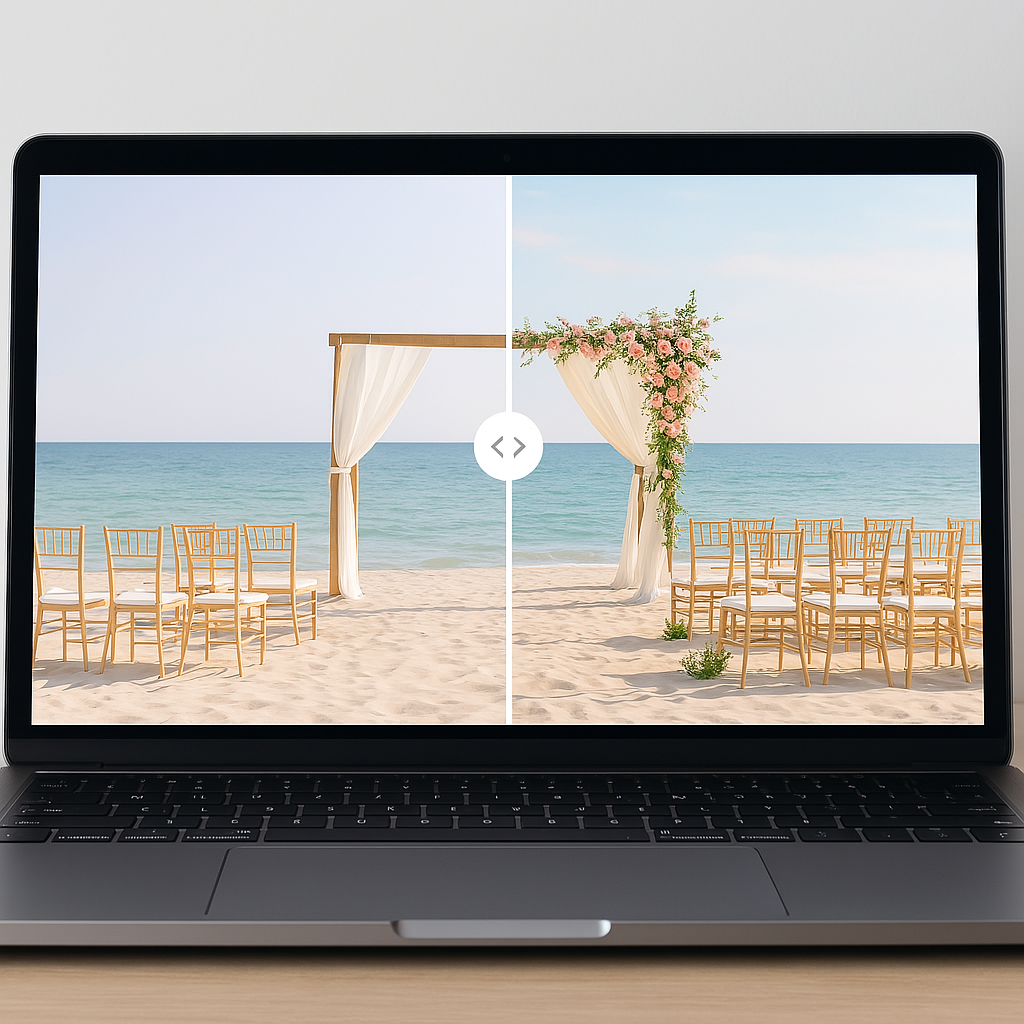
VenuePreview is not an overarching event management tool. It is a highly specialized, AI-powered visualization layer. It takes photographs of your actual venue and renders them as fully decorated, photorealistic scenes.
Think of it as the validation protocol that sits between your Pinterest moodboard and your vendor contracts.
What VenuePreview Does
The system operates on a straightforward but powerful premise. You capture and upload one to three photos of your empty or undecorated event space. The system analyzes the spatial constraints, lighting, and architecture of your specific room.
You then select from curated style templates and color palettes that match your aesthetic goals. Our generative AI engine processes these inputs to create between forty and two hundred realistic visualizations of your venue fully decorated. You can then download these specific renderings to share directly with your florist, planner, and rental partners. You move from an empty room to a finalized design without a single guess.
Why This Matters for 2026 Couples
As of May 2026, the wedding market operates on increasingly compressed timelines. Couples are booking vendors earlier and making massive financial commitments based purely on conceptual discussions. This dynamic creates acute "visualization anxiety."
Couples constantly second-guess their choices. They wonder if a dark color palette will consume the natural light in their ballroom. They debate whether long banquet tables will restrict guest flow compared to standard rounds. They worry that tall floral centerpieces will block crucial sightlines during toasts. VenuePreview forces these abstract worries into concrete visual data. You can definitively see your venue as it will look before you sign non-refundable vendor contracts.
Key Benefits
The return on investment for visualization is massive, especially for weddings operating within the standard $25K to $75K budget range.
- Visualize your wedding before you spend. You can virtually test contrasting color schemes, lighting dynamics, and spatial layouts. This eliminates the risk of expensive decor mistakes.
- Confidence in every planning decision. You no longer have to hope your rental choices will complement your venue. You can provide your vendors with exact visual references of the required outcome.
- Fast turnaround for tight timelines. The platform delivers dozens of photorealistic renderings in roughly ten to twenty-five minutes. This rapid feedback loop allows you to make data-backed decisions during a single vendor consultation.
- Better communication with vendors. Sharing a concrete rendering aligns all stakeholders immediately. Your florist, lighting technician, and planner all operate from the exact same visual target.
Packages & Pricing
We structured our system as a direct-to-consumer, one-time purchase model. There are no recurring subscription fees. You review our visualization tiers and select the output volume that matches your decision-making needs.
The Basic package is nineteen dollars and delivers forty unique visualizations across two different style variations. The system processes and delivers these images in ten to twenty-five minutes, and includes standard email support.
For couples exploring broader aesthetics, the Premium package costs twenty-nine dollars. This tier increases the output to one hundred visualizations spanning five distinct styles. It also upgrades your account to priority support and unlocks dedicated vendor sharing tools.
Couples finalizing high-stakes design plans typically utilize the Luxury package for forty-nine dollars. This comprehensive option generates two hundred photorealistic variations across ten styles. It includes all priority support and sharing features while adding the ability to process custom style requests. All options are designed to facilitate rapid planning cycles.
How VenuePreview Fits With Your Other Apps
This software does not compete with your core database. It serves as a highly specialized plug-in to your existing stack.
You should absolutely continue to manage your RSVPs and budget tracking in your central planning app. You should still aggregate your high-level inspiration on visual search engines. VenuePreview simply steps in to bridge the gap between that unconstrained inspiration and the physical reality of your venue.
Once the AI generates your ideal setup, you export those exact images. You can embed them directly into your Notion database. You can attach them to your digital vendor briefs. You can link them to your central timeline. It provides the definitive visual truth for your entire planning ecosystem.
6. Communication, Messaging & Updates
Logistical planning is useless if that information fails to reach your stakeholders. Managing notifications and updates is a frequently underestimated friction point in the planning lifecycle.
Text-Based Wedding Tools
Relying on group emails for critical day-of updates is a failing strategy. Email open rates drop significantly during travel and weekend events. Text-based notification platforms provide a direct line to your guests.
You can schedule automated reminders for shuttle departures. You can instantly push weather contingency plans to the entire guest list. You can trigger simple nudges for unsubmitted RSVPs. These platforms operate strictly as a notification layer. They drastically reduce the time you spend individually managing lost or confused guests.
7. Music, Travel & Extras
A complete stack utilizes specialized consumer applications to handle peripheral logistics. These are not wedding-specific products, but they are mandatory for a smooth execution phase.
Audio curation is best handled by standard streaming platforms like Spotify or Apple Music. You can build collaborative playlists for distinct phases of the event and export these directly to your hired entertainment. Weather applications dictate your contingency planning for outdoor ceremonies. Travel aggregators like Google Flights or Airbnb are essential for coordinating room blocks and managing your own honeymoon logistics. These point solutions integrate smoothly into your overarching operational plan.
How to Build Your Perfect 2026 Wedding App Stack
Adopting every tool on the market creates redundant data silos. You must build a lean, intentional stack that solves specific operational problems. Focus on establishing these four core pillars.
- One all-in-one organizer. Select either The Knot, Zola, or a custom workspace. Use this strictly as your system of record for budgets, timelines, and vendor data.
- One guest-facing tool. Deploy Joy or a dedicated website builder. This acts as your customer portal for RSVPs and travel logistics.
- One inspiration tool. Utilize visual search engines for top-of-funnel ideation and color theory.
- One visualization tool. Integrate VenuePreview to apply your ideation to your physical space. This generates the exact visual parameters you will hand off to your vendors.
By constraining your stack to these four primary layers, you maintain total control over your data without suffering from software fatigue.
Building Your Modern 2026 Wedding Toolkit
Technology cannot eliminate every variable from your event. However, a properly structured app stack will drastically reduce your cognitive load, automate your logistics, and protect your budget from misaligned vendor expectations. The goal is to deploy software that absorbs the friction of project management.
For raw data and guest tracking, rely on established platforms that offer the best mobile integration. For aesthetic decisions, refuse to operate on blind faith. Abstract moodboards are no longer sufficient when allocating thousands of dollars to physical decor.
If you are ready to transition your planning from abstract hopes to concrete visuals, you need the right tools. You can move from an empty room to a fully realized design in minutes. Create your account today, and actually see your space decorated before you sign another contract. Build your stack wisely, and start visualizing your venue to execute your 2026 wedding with absolute precision.
Related Posts
- Top Wedding Planning Apps to Use in 2026 for a Flawless Day
- Top Wedding Planning Tools for Seamless Vendor and Guest Coordination (2026 Guide)
- Essential Wedding Planning Apps for a Stress-Free 2026
- Ultimate Wedding Planning Resources for 2025–2026 Couples
- Essential Wedding Coordination Tools for Vendors and Guests in 2026
Ready to Visualize Your Wedding Venue?
See exactly how your venue will look on your wedding day with AI-powered visualizations. Get started in minutes with packages starting at just $19.