Top Wedding Venues Around London for 130 Guests on a £50k Budget
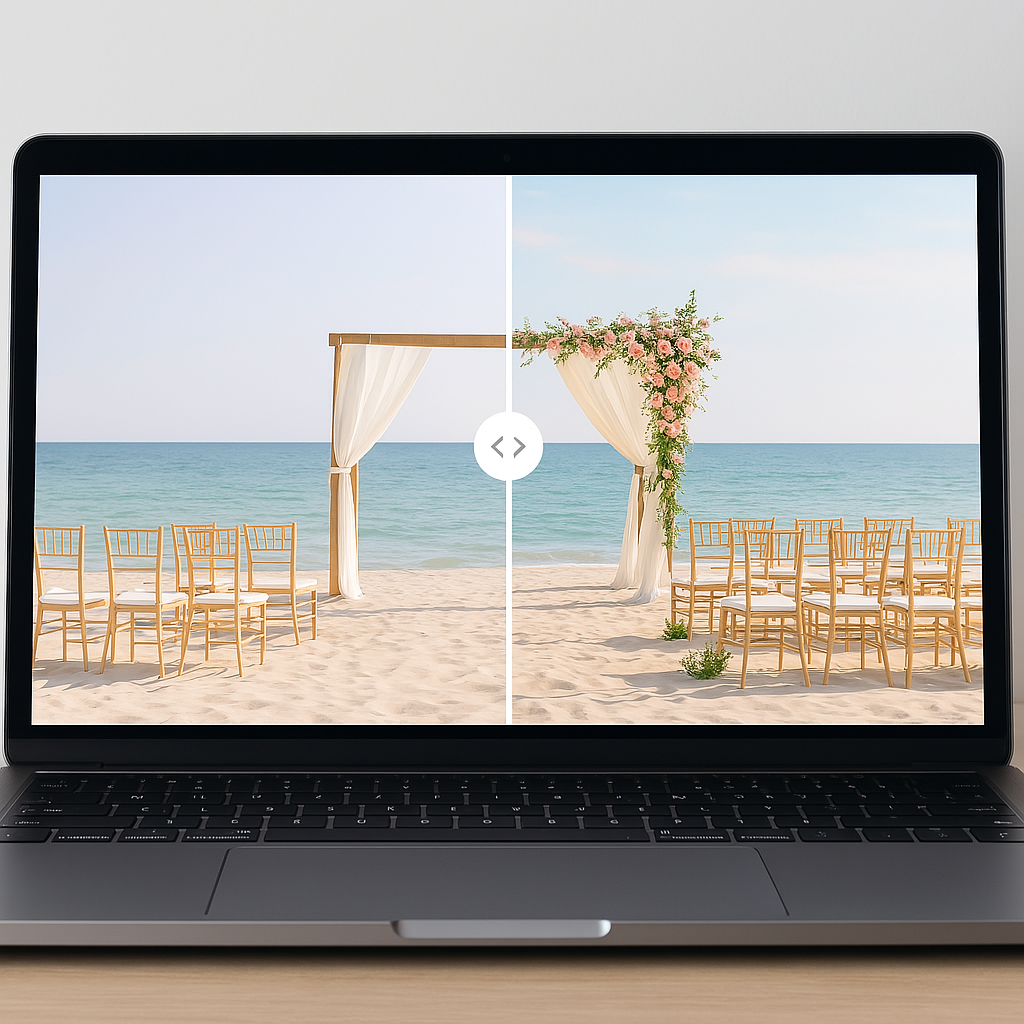
The venue selection process is fundamentally a resource allocation problem. You operate with rigid constraints: a strict £50,000 budget, a non-negotiable guest list of 130 people, and a geographic radius centered around London. Every single decision you make in this early stage drastically impacts the downstream math. Finding the right physical space is only the very first step in a complex acquisition funnel for your event.
The primary friction point in this process is not discovery or availability. The core friction is a profound lack of visual clarity. Couples are consistently asked to commit tens of thousands of pounds to empty civic halls, barren industrial spaces, or neutral hotel ballrooms based purely on imagination. This creates a massive "visualization gap" that leads directly to catastrophic budget overruns on unnecessary styling and rentals.
Solving this visualization gap requires modern tooling designed specifically for spatial rendering. As a critical piece of the modern wedding tech stack, you need to discover how you can solve visualization anxiety with VenuePreview. Our AI-powered platform allows you to test variables, visualize spatial outcomes, and allocate your capital with absolute confidence long before you sign a single vendor contract.
Planning a £50k Wedding for 130 Guests Around London: What’s Realistic in 2026?
Is a £50k budget realistic for a 130-guest London-area wedding?
As we analyze the market on this day in April 2026, couples on community forums consistently question if £50k is viable for a premium event. Retrospective data from 2024 demonstrates how rapidly core components like catering and spatial rentals accumulate. The reality is that £50k represents a highly competitive, mid to high-tier budget within the UK market.
Your guest count and your location serve as the primary multipliers for your total expenditure. Accommodating 130 people in or immediately adjacent to London creates intense upward pressure on your baseline operating costs. Every additional guest exponentially increases your liabilities across food, beverage, and required square footage.
You must understand that strategic trade-offs are mathematically unavoidable. You will need to carefully balance the architectural wow-factor of your chosen space against your catering scope and your overall design budget. Over-indexing on a premium location will systematically force reductions in your styling and entertainment allocations.
How venue costs typically break down for London and surrounds
Pricing models within the hospitality industry are notoriously opaque and highly variable. Venues typically utilize one of two core monetization strategies to extract value. They either deploy a flat hire fee combined with a strict minimum spend threshold, or they operate on a strict menu-per-person pricing model.
Based on verified reports from real couples, baseline venue hire fees in this geographic zone typically sit in the low to mid thousands. You then layer your variable catering and bar costs per guest directly on top of this fixed base. The financial velocity increases rapidly when you start adding premium modifiers.
Certain variables will spike your baseline operational costs significantly. Securing total exclusive hire, extending your party with mandatory late-night licenses, and targeting peak weekend dates will consume a massive percentage of your overall capital. Even within a healthy £50k total budget, these premium upgrades require rigorous justification.
Common worries couples have when choosing a venue
The mental load associated with venue shopping is immense and well documented. Real users consistently highlight three primary anxieties that stall their decision loops. They worry about fitting 120 to 150 guests comfortably, successfully negotiating exclusive access, and avoiding the devastating impact of hidden logistical costs.
The single biggest unquantified risk is spatial awareness and design projection. It is incredibly difficult for the average consumer to mentally project how a bare town hall or an empty pub will look when fully styled for 130 people. Couples often browse extensive digital directories on Hitched, Squaremeal, and Wezoree to source options.
Despite having access to endless lists of potential locations, couples remain paralyzed by the uncertainty of the final visual outcome. The inability to see the finished product creates a high-friction environment that delays contract signing and causes severe buyer anxiety.
How this guide will help you narrow down your venue choices
This guide provides a systematic, data-driven framework for effective venue selection. We will explicitly spotlight specific categories of spaces around London that mathematically support approximately 130 guests. We will ensure these spaces align properly within your £50k spending ceiling.
We will also explore advanced strategies to optimize your styling expenditure. You will learn exactly how to budget smarter by visually testing your specific design hypotheses before committing a single pound. Execution requires certainty, and certainty requires visual proof.
To achieve this, we will introduce the concept of using AI venue visualization as your primary planning tool. This technology fundamentally changes how you evaluate physical spaces, allowing you to bypass imagination and operate entirely on verified visual data.
Key Venue Criteria for 130 Guests Near London on a £50k Budget
Capacity and layout: making 130 guests feel comfortable, not cramped
Capacity is an absolute hard constraint that cannot be manipulated. Do not attempt to force 130 people into a physical footprint optimized for 80 attendees. Industry data shows venues frequently quote capacities ranging from 50 to 140 or 10 to 150 guests. You must analyze these maximum thresholds highly critically.
You need to clearly distinguish between a seated dining capacity and a standing reception capacity. Furthermore, you must measure the available dancefloor space and evaluate the transition zones between your ceremony room and your dining area. Spatial limitations dictate the energy of your event.
Flow is a critical user experience metric for your guests. If 130 people cannot move seamlessly between drinks, dinner, and dancing, the entire event will feel claustrophobic and poorly managed. Always optimize for movement and comfort over maximum density.
Location trade-offs: central London vs “around London” options
Geography dictates pricing power and operational flexibility. Discussions among couples emphasize the immense strategic value of looking just outside the central urban zones. A brief thirty-minute train ride from the city center opens up access to historic castles, expansive country houses, and premium estates.
Moving slightly outside Zone 1 and Zone 2 unlocks significantly better capital efficiency. It drastically increases your probability of securing exclusive hire and provides access to far superior outdoor environments. However, you must accurately model the friction of guest travel.
You must factor rail links, available overnight parking, and the proximity of local accommodation directly into your master logistics plan. An isolated venue might save you money on the lease, but it shifts the logistical burden directly onto your attendees.
Cost structures: venue hire, minimum spends and per-head catering
You must model your projected expenses accurately to survive the initial planning phase. Research indicates that venues frequently implement a minimum spend from around £1,000 to £3,600 just to secure the date. They pair this with set menus from £20 to £85+ per person.
These numbers scale aggressively when multiplied by 130 guests. Minimum spend packages are extremely common in premium pub and restaurant environments. If you manage these thresholds strategically, they can actually be highly budget-friendly options that consolidate your vendor list.
However, a high per-head catering cost for 130 people will accelerate your financial burn rate faster than any other line item. Modeling your food and beverage costs early is the only proven way to protect your £50k ceiling from inevitable scope creep.
Style and flexibility: from town halls to industrial lofts and pubs
The Greater London area offers distinct architectural categories, each with its own economic profile. Popular industry roundups frequently feature civic town halls, industrial warehouses, historic museums, restored pubs, and boutique hotels. Each category operates with a vastly different baseline aesthetic.
You must understand the visual delta between a completely blank-canvas venue and a pre-styled hospitality space. Pre-styled boutique hotels require minimal design intervention. Conversely, blank spaces demand a significantly higher capital investment to achieve a premium, finished look.
This architectural reality makes it imperative to preview your design concepts in advance. If you lease an empty warehouse, you are adopting a massive styling liability that must be accounted for in your initial projections.
Popular Types of Wedding Venues Around London That Work for 130 Guests
Town halls and civic buildings: character and value
Civic architecture offers incredible baseline value and historic prestige. Industry commentary consistently highlights London town halls in Islington, Old Marylebone, Chelsea, and Hackney as highly desirable assets. They deliver immediate visual impact without requiring heavy structural dressing.
Many of these civic buildings feature dedicated ceremony spaces calibrated perfectly for mid-sized audiences of 130. You can easily pair these administrative spaces with a secondary, separate reception location. The core advantage lies in stunning architecture and highly experienced in-house management teams.
The primary drawback involves rigid operational rules. Civic buildings strictly enforce regulations regarding setup timing, acceptable styling elements, and non-negotiable late-night noise curfews. You trade operational freedom for architectural grandeur.
Pubs, restaurants and urban chic spaces
Hospitality venues offer a streamlined, highly efficient operational model. High-end pubs and refined urban restaurants rely heavily on minimum spend requirements and structured set menus. This effectively consolidates your venue and your caterer into a single contract.
These environments provide inherent atmosphere and established in-house infrastructure. This drastically reduces your reliance on external styling teams and expensive equipment rentals. You are essentially renting a fully functional, pre-designed ecosystem.
These spaces possess a distinct capacity sweet spot. They are mathematically optimized to comfortably host between 100 and 170 guests, making them the ideal structural fit for a 130-person event on a strict budget.
Industrial and warehouse-style venues
The industrial aesthetic remains highly resilient and exceptionally popular in the current market. Converted dairies and expansive warehouse spaces are frequently optimized for guest counts hovering around 140. They provide immense spatial flexibility and a highly modern undertone.
Couples are drawn to the exposed brickwork, soaring ceilings, and the absolute blank canvas these environments provide. They allow for maximum creative control and bespoke design. However, this total freedom is a dangerous trap for the financially unprepared planner.
These cavernous spaces require massive capital investments in structural lighting, suspended floral installations, and complete furniture rentals to avoid feeling cold and barren. You must plan this expenditure carefully to stay within a £50k framework.
Museums, galleries and quirky spaces
Cultural institutions offer unmatched visual leverage and cultural cachet. Venues situated in the Docklands or central museum districts double as immersive, historic backdrops. They instantly elevate the perceived production value and scale of your event.
Booking a historically significant space severely reduces your reliance on heavy structural styling. The existing architecture and exhibits do the heavy lifting for your design. But these unique benefits come with incredibly strict operational trade-offs that you must accept.
You will likely face extreme setup restrictions to protect exhibits. You will also deal with mandatory usage of highly expensive approved caterers and inflated per-head menu costs that protect the venue from liability.
Balancing Your £50k Budget: Venue, Food, Décor and Photography
A sample budget split for 130 guests around London
Effective financial management requires disciplined resource allocation. Based on extensive user breakdowns, a standard model positions venue acquisition and catering as the dominant expenditure block. Photography, attire, styling, and entertainment must ruthlessly share the remaining capital.
For a 130-guest event, venue hire and food will consume the vast majority of your £50,000 threshold. You cannot negotiate this basic, underlying math. The structural costs are fixed, leaving only the variable styling and media costs up for optimization.
You must build a defensive financial buffer into your master spreadsheet. Always retain a strict contingency fund to absorb unexpected baseline fees, mandatory late licenses, emergency staffing requirements, or inevitable styling add-ons that occur late in the cycle.
Where couples tend to overspend: décor and ‘finishing touches’
Scope creep is the absolute enemy of the £50k budget. User data reveals that elaborate floral installations, custom tabletop styling, and minor aesthetic upgrades silently bleed thousands of pounds from the budget. The financial risk is highly asymmetrical in the final months.
Blank-canvas venues present the highest probability of catastrophic overspend because couples lack the baseline data to know exactly how much design is "enough." They continue buying items to fill the perceived void. The root cause of this behavior is highly emotional rather than logical.
Couples anchor their design expectations to heavily curated Pinterest boards. They fall in love with isolated details and only realize the true, compounded financial impact when final vendor quotes arrive.
The challenge of visualising different venue styles before you commit
Marketing material provided by venues is inherently deceptive. Directories display perfectly optimized, heavily styled, and professionally lit photography. These curated images rarely align with your specific architectural footprint, your chosen layout, or your distinct color palette.
It is functionally impossible for most people to accurately map a 130-person floorplan onto an empty hall during a rushed, thirty-minute daytime site visit. This visual ambiguity is dangerous. It forces you to make massive financial commitments based entirely on abstract hope.
This confusion connects directly to the high risk of buyer's remorse. Booking a venue or committing to a styling package that fundamentally fails to execute your core vision is a failure of the visualization process, not a failure of budget.
Why visual clarity is now as important as price and capacity
The event planning landscape has evolved aggressively. Consumers operating in 2026 are accustomed to advanced visual discovery tools and dynamic inspiration platforms. However, they still suffer from a severe lack of hyper-specific, localized visual data for their exact physical spaces.
Gaining clear visual data is now a primary, required stress reduction tactic. It aligns decision-making across couples, extended families, and professional planners. It systematically eliminates post-purchase dissonance by providing absolute proof of concept before payment.
A dedicated visualization layer must now sit directly on top of your standard planning stack. This specialized layer fills the execution gap, ensuring that the beautiful ideas you discover online can actually be deployed inside your specific venue.
How to Shortlist the Right Venues Around London for Your Guest Count and Style
Step 1: Use directories and blogs to build a longlist
Top of funnel discovery requires high volume and broad data aggregation. Start by running wide queries across major directory platforms and highly curated aggregator sites. You need to cast a wide net initially to capture all possible structural options.
Implement strict filtering protocols immediately. Isolate your search exclusively to spaces supporting exactly 130 guests. Target geographic zones positioned just outside the central London core. Look for explicit, budget-friendly signaling in their marketing copy to ensure alignment with your £50k cap.
Your objective in this phase is strictly numerical. Advise saving 10 to 20 viable options that appear to match your specific capacity needs and headline pricing parameters. Do not worry about interior décor or styling potential at this stage.
Step 2: Filter by practical constraints (availability, travel, rules)
You must ruthlessly disqualify options that fail basic operational tests. Immediately request firm data on target date availability, specific exclusive hire policies, and rigid evening end times. Do not waste emotional energy on a space you cannot legally operate within.
Interrogate their catering infrastructure aggressively. Determine if you are locked into their in-house teams or if you can leverage external suppliers to control costs. Identify hard minimum spend floors and strict supplier restrictions that might break your budget model.
Applying these practical, structural filters will rapidly condense a bloated longlist. You will transform a chaotic list of 20 venues into a highly actionable shortlist of realistic, functional contenders.
Step 3: Compare how each venue could look for your wedding style
This is the exact stage where traditional planning methodologies completely break down. Most couples rely entirely on raw imagination or disjointed reference imagery rather than localized visual data. They guess rather than analyze the spatial reality.
You need to secure raw visual baseline data. Obtain clean, empty, or minimally decorated photographs of each shortlisted space from the venue manager. You will use these raw assets as the foundational layer for your styling blueprint.
Advanced AI tools have modernized this workflow. You should learn more about how VenuePreview turns empty spaces into decorated wedding scenes to seamlessly transform these empty reference shots into highly accurate, styled projections.
Step 4: Stress-test your budget before signing a venue contract
Never execute a venue contract based on optimistic assumptions. Build a dynamic, integrated spreadsheet. Input your fixed venue hire fee, your calculated per-head catering projection, and a specific, localized styling estimate for every single shortlisted option.
Realistic visual data allows you to formulate highly accurate styling hypotheses. You can visually confirm if your specific design approaches actually fit inside your £50k ceiling instead of guessing at floral volumes and rental needs.
The operational rule is absolute. Recommend only booking your venue once you have explicitly seen how the space operates visually within your budget, and you feel total mathematical confidence in the numbers.
From Empty Room to Dream Wedding: Introducing VenuePreview
What is VenuePreview and how does it fit into your venue search?
VenuePreview is an AI-powered wedding venue visualization service engineered to eliminate aesthetic guesswork. It focuses exclusively on the most critical design gap: showing you exactly how specific architectural spaces will appear when fully decorated to your specifications.
The platform fundamentally alters your planning workflow. It ingests standard photographs of empty or undecorated environments and outputs photorealistic wedding scenes mapped accurately to your chosen styles, color schemes, and lighting profiles.
We position VenuePreview as a highly specialized, complementary visualization layer. It is designed to run in parallel with comprehensive logistical management platforms like Zola, The Knot, or Pinterest. It is a targeted tool, not a bloated all-in-one app.
How VenuePreview works step-by-step for engaged couples
The operational flow is frictionless and highly optimized for speed. Users access the web application and simply upload one to three baseline photographs of their target, undecorated venue space.
You then select specific parameters from an extensive library of architectural style templates and highly curated color palettes that match your specific event vision. Our proprietary AI models immediately process these inputs against your raw structural photography.
The system generates between 40 and 200 distinct, photorealistic visualizations showing the venue fully decorated. These assets are delivered rapidly in just 10 to 25 minutes. Users can instantly review the outputs, select their highest-performing design concepts, and download them for immediate distribution.
Key benefits for couples planning a £50k, 130-guest wedding
We provide absolute visual certainty before financial commitment. Our platform empowers you to observe your final spatial configuration before you secure expensive vendors or purchase non-refundable décor elements.
This entirely eradicates "visualization anxiety" and massively reduces cognitive load. It provides critical risk mitigation for couples dealing with intimidating, blank-canvas industrial warehouses or empty civic halls. It serves as your primary defense mechanism against design errors.
The cost-saving applications are immense. By virtually testing centerpieces, spatial flow, and structural lighting in advance, you systematically avoid catastrophic styling mistakes. These realistic visuals make it infinitely easier to communicate with florists and stylists, aligning expectations flawlessly.
Why VenuePreview is different from generic photo editing or 3D tools
Market positioning matters, and our architecture is highly specialized. VenuePreview is explicitly not a generic image manipulation tool. It is not a clumsy virtual reality walkthrough gimmick, and it makes zero attempt to operate as a general logistical wedding app.
Our AI models are trained exclusively on event architecture, specific reception styling, and time-of-day lighting data. This generates vastly superior, highly tailored results compared to standard software. We outpace traditional 3D renderings and physical mockups entirely.
Legacy 3D pipelines are prohibitively slow, highly expensive, and detached from your actual photographic data. VenuePreview is optimized for a singular, high-value outcome: giving you absolute confidence in every single planning decision related to your venue décor.
Choosing the Right VenuePreview Package for Your Wedding
Overview of VenuePreview’s packages and pricing
We utilize a highly transparent, direct-to-consumer monetization model based on one-time purchase tiers. We offer three optimized levels designed to support different user requirements. To view the complete architecture, you can explore the VenuePreview packages and pricing options.
The Basic package is priced at $19, delivering 40 visualizations across 2 style variations in 10-25 minutes, supported by standard email access. The Premium tier scales up to $29, outputting 100 visualizations across 5 variations with priority support and vendor sharing tools.
The Luxury tier delivers maximum data density. For $49, users receive 200 high-fidelity visualizations across 10 distinct style variations. This tier includes rapid delivery, priority operational support, vendor sharing tools, and access to custom stylistic inputs.
Which package is best for a £50k, 130-guest London-area wedding?
Product selection depends directly on your specific planning velocity and iteration needs. We position the Premium package as the strongest fit for the vast majority of couples. It provides sufficient variation to rigorously test one primary venue and includes the necessary vendor sharing infrastructure.
The Basic tier is highly effective for couples who already possess a locked-in design thesis. It serves perfectly as a final confirmation step to validate a couple of looks before executing final financial decisions.
We heavily recommend the Luxury package for highly design-conscious couples or professional planners. It provides the required bandwidth to run exhaustive, deep-dive tests across multiple complex themes, lighting moods, and alternative color schemes.
How to use your visualizations to tighten your décor and venue choices
Visual data is useless without strategic application. You must actively weaponize your downloaded imagery. Use the platform to directly compare different structural layouts and aesthetic styles for the exact same venue to determine what suits 130 guests best.
Distribute your highest-performing renders to your styling teams, florists, and rental suppliers. Demand highly accurate, binding quotes based directly on the visual evidence provided in your VenuePreview outputs.
Establishing a clear visual baseline accelerates the decision loop rapidly. It stops endless revision cycles, eliminates frustrating back-and-forth communication, and drastically reduces the planning fatigue that plagues the final months.
Real planning scenarios where VenuePreview saves money and stress
Consider a standard cost-optimization problem. A couple is torn between a cheaper pub venue and a highly expensive industrial space. VenuePreview allows them to instantly model the massive styling expenditure required to elevate the pub versus the warehouse, making the true costs visible.
In a secondary scenario, a couple is tempted to over-index on premium floral installations. By simulating both high-density and simplified arrangements, they realize the cheaper, minimal viable product is actually superior. They avoid thousands in overspending.
Furthermore, professional planners and photographers leverage these exact outputs as strict operational references. You can see more articles on the VenuePreview wedding planning blog detailing how industry experts use our tool to align shot lists and finalize complex styling plans.
Building Your Modern Wedding Toolkit
Checklist before you sign on a venue for your 130-guest wedding
Flawless execution requires disciplined protocols. Run this summary checklist before authorizing any venue transaction. Verify your capacity fit, demand a granular cost breakdown, map out travel and accommodation logistics, audit their décor rules, and lock your dates.
Once the logistical data is secure, obtain simple, unedited photographs of the empty or minimally decorated venue from multiple strategic angles. Do not finalize any contracts before securing this visual baseline.
Inject these baseline assets into VenuePreview immediately. You must observe your potential set-up and validate your design hypothesis before you commit to massive, non-refundable décor or rental contracts.
How to integrate VenuePreview into your wider planning toolkit
Effective systems rely on tightly integrated, specialized tooling. Couples should continue to extract high-level inspiration from aggregator platforms like Pinterest or Hitched. However, you must pair those top-of-funnel tools with VenuePreview to generate venue-specific visual data.
Inject your VenuePreview outputs directly into your core operational documents. Embed them in your digital mood boards and attach them to every single email sent to your supplier network to ensure absolute clarity.
This rigorous methodology ensures your £50k budget remains highly focused. You deploy capital strictly against choices you have already seen and validated, rather than wasting funds on abstract guesswork and hope.
Start visualizing your venue today
The planning phase should be driven entirely by concrete data and visual clarity, not crippling anxiety and assumption. You now possess the specialized tooling necessary to remove the guesswork from your most significant financial commitments.
From an empty room to a dream wedding, you have the power to control your aesthetic outcome. We invite you to visit our platform, select your optimal package, and upload your raw venue photography today.
Stop guessing and start visualizing your wedding venue before you spend on décor. See your venue exactly as it will look, lock in your final decisions with total authority, and execute your planning process with absolute confidence.
Related Posts
Ready to Visualize Your Wedding Venue?
See exactly how your venue will look on your wedding day with AI-powered visualizations. Get started in minutes with packages starting at just $19.