How to Negotiate with Wedding Vendors (Without Being Awkward)
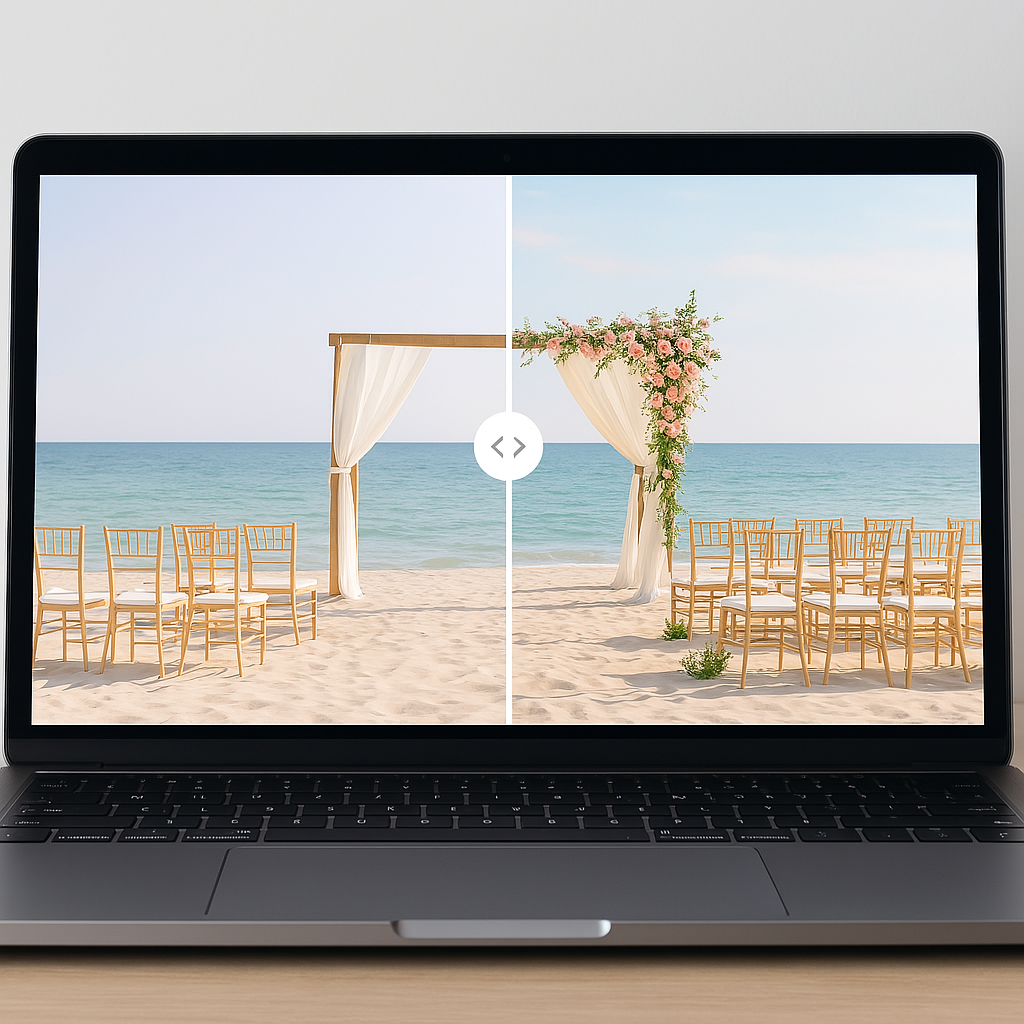
The fundamental problem with wedding planning is information asymmetry. Vendors execute events every weekend, while most couples are navigating a high-stakes marketplace for the very first time. This dynamic creates massive friction when it comes to pricing. If you have ever stared at a wedding quote and felt your stomach drop, you are experiencing the direct result of this knowledge gap.
Couples planning 2026 weddings face a particularly challenging economic landscape. Inflation, supply chain constraints, and elevated labor costs have fundamentally shifted the baseline. According to a 2026 industry report, the average wedding in the United States now costs approximately $34,200. To survive this environment without overextending your finances, you must learn to negotiate.
However, negotiation does not mean haggling. It requires a systematic approach to scoping, alignment, and visual clarity. Before sending a single email to a vendor, smart couples discover how you can solve decor uncertainty using VenuePreview. Our AI-powered venue visualization platform turns simple photos of empty rooms into photorealistic, fully decorated renderings. By establishing exactly what you need visually, you eliminate the guesswork that traditionally inflates vendor quotes. This guide details the exact frameworks you need to negotiate effectively, adjust project scopes, and build a wedding budget based on reality instead of assumptions.
First: What "Negotiation" With Wedding Vendors Really Means
The most common mistake couples make is treating wedding vendors like retail commodities. When you ask a vendor for a "better price" on the exact same package, you are asking them to intentionally compress their profit margins. This approach immediately creates an adversarial relationship.
In the service industry, true negotiation is about scope adjustment. The work that wedding vendors perform carries hard costs. These include labor, materials, insurance, and highly specialized expertise. A vendor cannot simply reduce their hourly labor rate without fundamentally compromising the viability of their business.
Instead of demanding arbitrary discounts, strategic negotiation focuses on four specific levers:
- Adjusting the scope of work to require fewer hours or fewer deliverables.
- Swapping premium materials for more affordable alternatives.
- Securing added value through flexible timing.
- Choosing off-peak dates to capitalize on underutilized inventory.
You must also ignore the myth of the "wedding tax." Many couples believe vendors artificially inflate prices the moment they hear the word "wedding." In reality, weddings require exponentially more liability management, timeline coordination, and client communication than a standard corporate event. Once you understand that you are paying for risk mitigation, the conversation shifts from haggling to collaborative problem solving.
Avoid the Awkwardness: 5 Ground Rules
Successful negotiation relies on setting clear parameters before the first quote is even drafted. These five ground rules ensure your conversations remain professional and productive.
- Be upfront about your budget immediately. Do not wait until you are deep into the planning process to reveal your constraints. Giving a vendor a real, mathematical range saves time and filters out mismatched partnerships instantly.
- Separate price from value. Understand the unit economics of the service. An entry-level photographer charges less because they lack the redundant equipment, liability insurance, and pattern recognition of a veteran. You are not just paying for photos. You are paying for a guarantee.
- Aim for a win-win outcome. Your objective is to find an intersection between your financial reality and the vendor's required margin. Approaching the conversation as a battle to be won will only yield resentful vendors who deliver minimum viable effort.
- Be ready to walk away. The ultimate negotiation leverage is your willingness to pass on a deal. If a quote is mathematically impossible for your budget, thank them professionally and move on. Financial overextension has severe long-term consequences. Recent studies reveal that 67% of newlyweds in 2025 took on debt to finance their events.
- Put everything in writing. Verbal agreements hold zero weight on the day of the event. If you negotiate a smaller floral package or a waived venue fee, that exact adjustment must exist in the signed contract.
Step 1: Do Your Homework (So You Don't Lowball By Accident)
You cannot negotiate effectively if you do not understand the baseline physics of your local market. Asking a top-tier professional to cut their standard rate by 60% does not make you a savvy negotiator. It simply signals that you are out of touch with market realities.
First, identify your regional averages. Major platforms like The Knot and Zola publish localized data that provides a realistic starting point. A wedding in Manhattan carries a fundamentally different cost structure than a wedding in the Midwest. Next, define your strict priorities. Most couples allocate roughly 29% of their budget to the venue, 24% to catering, and 10% to media capture. You must decide which categories are non-negotiable for your specific vision.
This is the exact phase where visual clarity becomes your ultimate advantage. Vendors cannot price a moving target. If you provide vague descriptions of "romantic elegance," vendors will quote high to cover potential miscommunications.
By using VenuePreview, you bypass this entirely. You can see your venue as it will look by generating dozens of AI visualizations tailored to your specific style. When you hand a vendor a photorealistic rendering of your exact space and ask them to quote that specific output, you eliminate the friction of uncertainty. Precise inputs generate precise pricing.
Step 2: Get Multiple Quotes (Without Ghosting Anyone)
Information is leverage. You cannot evaluate the fairness of a quote if you have no comparative data. Sourcing multiple proposals is a mandatory step in the procurement process.
Select three to five vendors in each major category. Send them an identical, highly structured inquiry. You must include your date, guest count, location, style references, and hard budget ceiling. Consistency in your outreach ensures you receive apples-to-apples comparisons.
When the quotes arrive, demand an itemized breakdown. A lump-sum proposal hides the exact variables you need to adjust. Look at the specific unit costs. Compare the number of coverage hours. Identify whether setup, breakdown, and travel fees are baked into the core price or added as line items.
If one vendor's quote is significantly higher, do not immediately assume they are price-gouging. In many cases, their base package simply includes higher-end materials or more labor hours. Your job is to normalize the data before starting the negotiation loop.
Step 3: Start the Conversation the Right Way
You do not need aggressive tactics to negotiate. You need clear, concise communication frameworks. The following scripts remove the emotional friction from the process.
When the quote is a little above budget
Your goal here is minor scope reduction. Acknowledge their expertise, state your constraint, and ask for their strategic input.
"Thank you for this detailed proposal. We truly respect your work. Your quote is currently at $8,500, and our strict ceiling for this category is $7,000. Is there an opportunity to adjust the scope or simplify the deliverables to close this gap?"
When the quote is way above budget
When the gap is massive, asking for a discount is insulting. Instead, pivot to discover unadvertised, lower-tier service options.
"We appreciate you building this proposal. Unfortunately, this package is outside our mathematical reality right now. Before we move in a different direction, do you offer any simplified or abbreviated packages that land closer to the $4,000 range?"
When you want to explore options, not demand a discount
This approach treats the vendor as a consultant rather than an adversary. It transfers the problem-solving burden to the expert.
"We want to partner with you for our event. If we cap our spend at $5,500, how would you restructure this package regarding hours, materials, or staff to meet that number?"
Step 4: Know What's Usually Negotiable (By Vendor Type)
Every vendor category operates on a different business model. Understanding these distinct unit economics allows you to pull the correct negotiation levers.
Venues
Venues sell time and space. Their inventory is highly perishable. Once a Saturday passes, they can never monetize it again.
More negotiable: Dates and times are your highest-leverage variables. Friday or Sunday events carry lower baseline costs. Daytime or brunch timelines drastically reduce minimums. You can also negotiate waived ceremony fees or included furniture rentals if the venue already owns the assets. Less negotiable: Peak season Saturday dates are rarely discounted because demand exceeds supply. Strict in-house catering minimums at hotels are similarly rigid.
Caterers & Bakers
Food and beverage vendors operate on tight margins governed by wholesale food costs and intense labor requirements.
More negotiable: Service style is your biggest lever. Swapping a plated, multi-course dinner for a buffet or family-style service drastically reduces the required ratio of kitchen staff to guests. You can also negotiate the menu composition by trading premium proteins for more sustainable, cost-effective options. Less negotiable: Base labor rates, server wages, and premium ingredient costs cannot be compressed.
Photographers & Videographers
Media professionals scale their businesses based on the time they commit to an event and the subsequent hours required for post-production.
More negotiable: Time on site is highly flexible. Reducing an unlimited package to six hours of targeted coverage generates immediate savings. You can also defer costs by removing physical albums from the initial contract and purchasing them a year later. Less negotiable: The primary shooter's day rate and copyright ownership are fundamental to their business model and rarely subject to negotiation.
Florists & Decor / Rentals
Floral design is an intersection of agriculture, logistics, and art. Current figures show florist quotes average $6,345 for floral design and decor. This is the category where couples routinely overspend due to a lack of visual confidence.
More negotiable: Bloom selection dictates pricing. Swapping imported, out-of-season flowers for local, in-season flora drops material costs instantly. Simplifying the sheer volume of table installations is another massive lever. Less negotiable: Labor fees for complex, hanging installations.
To save money on décor mistakes, you must stop guessing. When you hand a florist a VenuePreview rendering, they no longer have to build a buffer into their quote to cover vague expectations. They know exactly how many stems and vessels the design requires. This precision engineering keeps quotes anchored to reality.
DJs, Bands, & Entertainment
Entertainment pricing scales entirely on the number of humans required and the duration of the performance.
More negotiable: You can reduce costs by limiting the hours of live coverage. Consolidating the setup location so the DJ does not have to move equipment between the ceremony and reception also strips out labor fees. Less negotiable: The base rate for professional musicians. Every member of a live band requires a living wage for the evening.
Step 5: Use Visuals to Cut Costs Before You Negotiate
The most insidious hidden cost in wedding planning is uncertainty. When couples cannot accurately visualize an empty ballroom, they panic. They order massive floral installations "just in case" the room feels bare. They upgrade chairs because they cannot picture how the standard options interact with the linens. Fear drives over-purchasing.
You can halt this cycle by applying a systematic visualization framework. With VenuePreview, you deploy technology to test your assumptions before deploying capital.
First, use our platform to test different decor densities. Generate one set of images with minimal floral arrangements and another with a maximalist approach. You will often discover that the architecture of the venue requires far less enhancement than you assumed. This data allows you to proactively slash your rental requirements.
Second, you can easily compare venue styles head-to-head. Sometimes a venue with a higher base rental fee requires zero additional draping or lighting, making it mathematically cheaper than a "budget" venue that demands heavy styling.
Finally, visual proof eliminates vendor upselling. When you walk into a meeting with a photorealistic blueprint of your exact space, you control the narrative. The conversation shifts from "what could we do" to "execute this exact specification." You are buying confidence in every planning decision.
Step 6: How to Answer "Is This Your Best Price?"
The phrase "Is this your best price?" is a blunt instrument. It puts vendors on the defensive because it implies their initial quote was inherently dishonest.
A strategic negotiator approaches this phase with nuance. If you need to test the absolute floor of a pricing structure, frame it around flexibility rather than discounts.
A highly effective response model looks like this: Start by acknowledging the undeniable quality of their portfolio. Next, reiterate the exact mathematical ceiling of your budget. Finally, ask a closed-ended question regarding flexibility.
"We are thoroughly impressed by this proposal. We are attempting to keep this line item capped at $3,000. Is there any flexibility built into this specific package, or is this a firm rate for our date? We are completely comfortable if it is firm; we just need to ensure we have explored every variable."
This framework gives the vendor an elegant exit. If they have margin to spare, they will offer it here. If they do not, they can say no without damaging the working relationship.
Step 7: When Negotiation Fails (And That's Okay)
Not every negotiation ends in an agreement. Market dynamics dictate that highly sought-after vendors during peak season have zero incentive to negotiate. They possess total leverage because demand for their time outpaces their available calendar slots.
When you exhaust your scope-reduction options and the price remains untenable, you must walk away. Do not attempt to guilt the professional. Do not leave them hanging in your inbox.
Send a definitive, polite rejection. State clearly that the numbers do not align with your current financial modeling, thank them for their detailed attention, and formally release the date. This professional courtesy leaves the door open. Occasionally, a vendor will experience a sudden cancellation months later and reach back out with a highly favorable adjusted rate.
Once you walk away, pivot your strategy. Look for aggressive, highly talented professionals who are in their second or third year of business. These vendors are actively trying to capture market share and will frequently offer premium effort at reduced rates to build their portfolios.
Quick Do's and Don'ts for Non-Awkward Negotiation
Execution is everything. Keep these operational constraints in mind during every vendor interaction.
Do:
- State your actual budget early and often.
- Bring concrete, visual blueprints to every consultation.
- Ask vendors to solve your budget constraints using their domain expertise.
- Read the final contract to verify all adjusted terms are explicitly listed.
Don't:
- Demand luxury-tier output on a localized, entry-level budget.
- Weaponize quotes by pitting vendors against each other in a race to the bottom.
- Assume peak Saturday dates carry any room for negotiation.
- Ghost a professional after they spend three hours building you a custom proposal.
How VenuePreview Makes Negotiation Easier (And Less Stressful)
Negotiation fundamentally breaks down when both parties are operating on assumptions. When you guess how a room will look, you overspend on decor to cover your anxiety. When vendors guess what you want, they overcharge to protect their margins from scope creep.
VenuePreview injects absolute clarity into this system. We eliminate visualization anxiety so you can plan with strategy instead of hope. From an empty room to a dream wedding, our AI engine delivers photorealistic evidence of your exact design.
You do not need to spend thousands on physical mockups. For a streamlined investment, our Basic tier provides 40 unique visualizations in two different styles for just $19. For couples requiring deeper exploration, the Premium package generates 100 variations and includes vendor sharing tools. Every rendering is delivered directly to you in 10 to 25 minutes.
Stop guessing. Stop overpaying for unnecessary rentals. Build a bulletproof visual reference and negotiate from a position of absolute strength.
Start Visualizing Your Venue to take control of your wedding budget today.
Related Posts
Ready to Visualize Your Wedding Venue?
See exactly how your venue will look on your wedding day with AI-powered visualizations. Get started in minutes with packages starting at just $19.