Ceremony and Reception in the Same Room
Quick answer: can you hold the ceremony and reception in the same room?
Yes. Many couples do, usually for one of three reasons: the venue has only one suitable space, the weather rules out an outdoor ceremony, or they want guests to stay in one place. There are two ways to plan it:
- Flip the room: hold the ceremony with rows of chairs, move guests out for a cocktail hour, and reset the room for dinner.
- Skip the flip: seat guests at their dinner tables for the ceremony, so nothing has to move.
The right choice depends on whether the venue has a second space for guests during a flip, how much time and staff the venue gives you, and how many guests you are seating.
Flip or no flip: how to decide
| Question | Points toward a flip | Points toward no flip |
|---|---|---|
| Is there a second space (foyer, terrace, bar) where guests can wait? | Yes, comfortably | No, or only a corridor |
| Does the venue or caterer run flips regularly? | Yes, with a set crew and time | No, or they would need extra staff |
| Do you want a classic aisle with rows of chairs? | Yes | Not important |
| Is the guest list small enough for tables to face one spot? | Not important | Yes |
| Is the timeline tight? | There is time for a cocktail hour | Dinner follows the ceremony directly |
Ask the venue first. Many venues that offer one room have a standard way of handling both parts of the day, and their experience in that room is the best guide.
Planning a room flip
A flip works when guests have somewhere pleasant to go while the room changes.
Before the day:
- Agree the flip with the venue in writing: who moves the chairs, who sets the tables, and how long it takes.
- Decide what stays in place. Dinner tables can often be set around the edges or in an adjoining space before the ceremony and moved in afterwards. Ask whether that is possible in your room.
- Plan the cocktail hour space so it does not feel like a holding pen: drinks, a few high tables, music and something to look at. Our guide to cocktail hour spaces covers how to dress one.
On the day:
- Close the doors while the room is reset, so guests do not watch the crew work.
- Give guests a clear cue to return, such as an announcement or the doors opening.
- Keep the ceremony decor movable. Aisle arrangements and backdrop flowers can move to the head table or the entrance for dinner.
The FAQ how a ceremony to reception room flip works covers the flip itself step by step.
Planning without a flip
If there is nowhere for guests to wait, or the timeline is tight, seat guests at their dinner tables for the ceremony.
Make it work:
- Arrange the tables so every guest can see the ceremony spot. Turn chairs toward it, or leave the side of each table facing the ceremony without chairs.
- Leave an aisle between tables, even a short one, so the entrance still feels like an entrance.
- Keep centerpieces low or move them aside during the ceremony so they do not block sightlines.
- Use the dance floor as the ceremony space. It is usually open and central, and it becomes the dance floor again with no work at all.
This approach suits smaller weddings in particular, because a modest number of tables can all face one spot. With a large guest list, guests at the back tables may see very little, which is the main argument for a flip.
One focal point for both parts of the day
The most useful decision when one room does two jobs is to choose a single focal point that works for the ceremony and for dinner:
- a fireplace, a window wall or a feature wall the room already has;
- a backdrop that sits behind the ceremony spot and later behind the head table;
- an arch or floral installation that frames both the vows and the first dance.
When the ceremony spot becomes the head table or the dance floor, the decor does double duty and the room looks designed rather than reset. Our ceremony backdrop ideas include options that work for both.
Seating and the aisle
- Rows of chairs need the most space and the most work to reset, but give the classic aisle.
- Dinner tables angled toward the ceremony need no reset but give a shorter, less formal aisle.
- A mix is possible: rows near the front for close family, with other guests at tables behind.
Whichever you choose, mark reserved seats for family, and keep the aisle and exits clear. The venue sets the rules for walkways and exits, and they apply to the ceremony layout as well as the reception. Our post on wedding venue layout plans covers reception layouts in detail.
Decor that works for both
- Choose one palette for the ceremony and the reception, so nothing clashes when they share a room.
- Plan aisle decor that can move: lanterns, small arrangements or potted greenery that can line a walkway, then sit on tables.
- Light the room for both moods. Brighter light helps the ceremony and photographs; warmer, lower light suits dinner. If the venue has dimmers, agree when to change them.
- Keep the ceremony spot uncluttered, since it may become the dance floor.
For more on dressing the reception itself, see wedding reception decor ideas.
Mistakes to avoid
- Assuming a flip is quick. Ask the venue how long it actually takes in that room and with that crew.
- Leaving guests without drinks or seats during the flip.
- Forgetting sightlines when guests are seated at tables for the ceremony.
- Planning ceremony decor that cannot move or be reused.
- Not telling the photographer, who needs to know where the ceremony and reception will happen and when the room changes.
Where VenuePreview fits
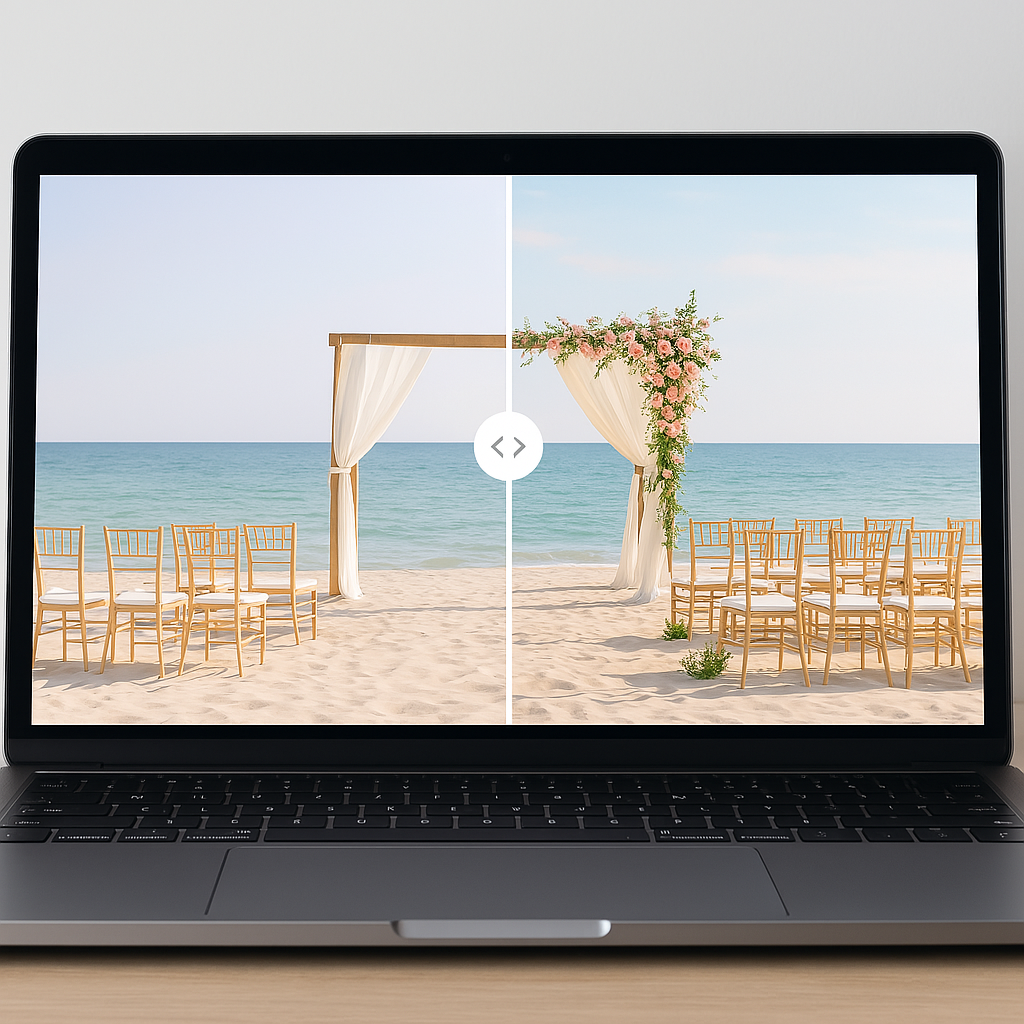
When one room serves the whole day, the decor has to work in that one space, and it is hard to judge from inspiration photos of other venues. VenuePreview lets you upload photos of your empty or undecorated venue, choose a style and colors, and get visualizations of that venue decorated, with details such as table settings, lighting and floral arrangements. You can compare different styles and color schemes for the same room before you spend on decor, and share the visualizations with your planner, florist and partner. See how it works.
Frequently asked questions
Is it a good idea to have the ceremony and reception in the same room?
It can be. It keeps guests in one place and suits venues with one main space or uncertain weather. The trade-off is either a room flip, which needs a second space and a crew, or a ceremony with guests seated at their tables, which works best for smaller weddings.
How long does a room flip take?
It depends on the room, the number of guests and the venue's crew, so ask your venue how long their flip takes in that space. Plan a cocktail hour that covers that time, in a separate area where guests are comfortable.
Where do guests go during a room flip?
Usually to a foyer, terrace, bar or adjoining room for a cocktail hour. If the venue has no second space, a flip is harder, and seating guests at their tables for the ceremony may be the better plan.
Can we have the ceremony on the dance floor?
Yes, and it is a common choice when there is no flip. The dance floor is usually central and open, guests at the tables around it can see the ceremony, and it becomes the dance floor again without any reset.
About the author
VenuePreview Editorial writes planning guides for couples who want to see their wedding venue decorated before committing to decor.
Related reading
- How a ceremony to reception room flip works
- Wedding venue design: how to plan the look of your venue
- Wedding venue layout plans
- Wedding ceremony backdrop ideas
See your one room decorated before you commit to a plan. Start with VenuePreview
See your venue decorated before you commit
Upload photos of your empty or undecorated venue, choose a style and colors, and compare visualizations of it decorated before you spend on decor.