Wedding Venue Transformation: How to Turn Any Space into Your Dream Wedding (Before You Spend a Dollar on Décor)
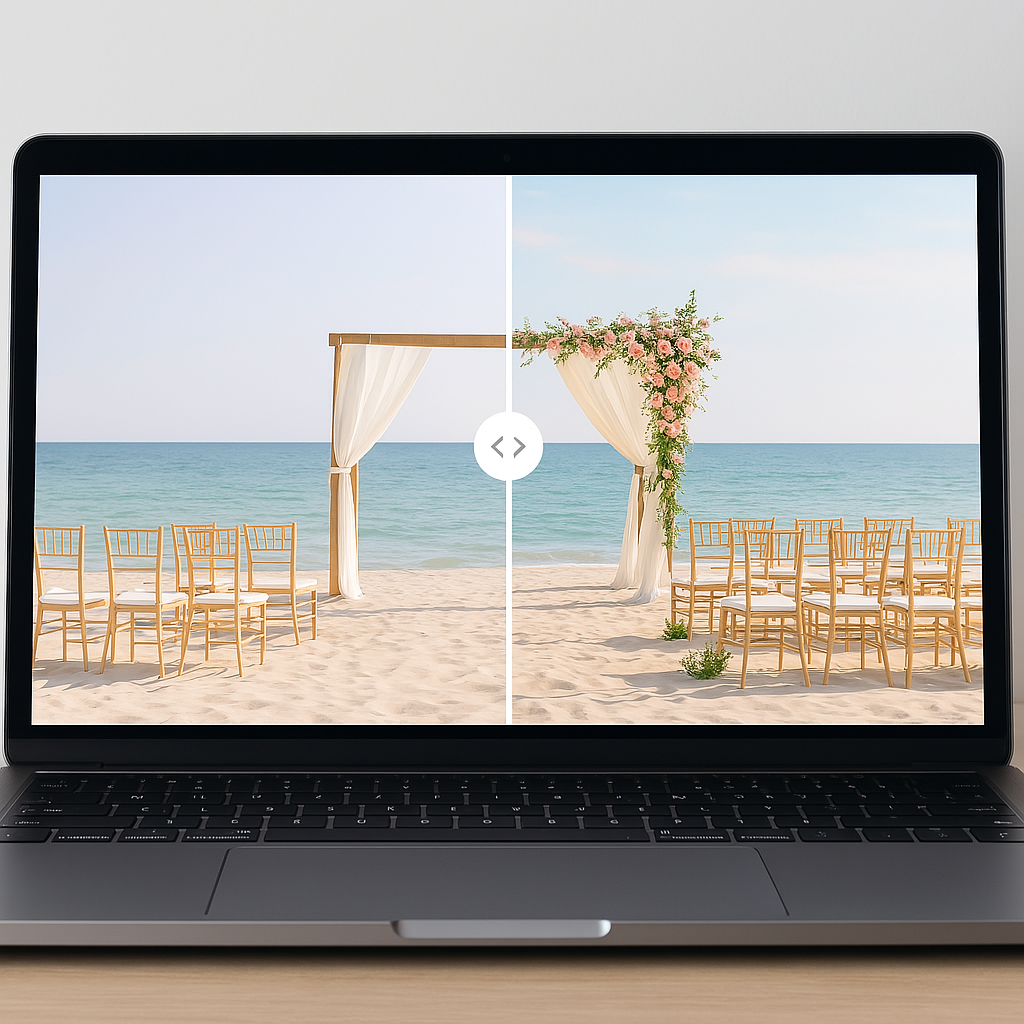
The gap between the venue you can afford and the venue you dream of is often the single greatest source of anxiety during engagement. You find a space that meets your logistical requirements. It has the right capacity, the right location, and the right price. Yet it feels "off." Perhaps the carpet is dated, the lighting is clinical, or the walls are a beige that inspires nothing but apathy. This is the moment where "wedding venue transformation" stops being a buzzword and becomes a critical strategic necessity.
The traditional approach to this problem is flawed. Most couples book a space and then attempt to layer decoration on top of it, hoping the result matches the Pinterest board they have built. This is a recipe for budget overruns and disappointment. To truly solve this, you need to validate your design choices before you sign contracts. This is why we built Venue Preview as a fundamental layer in the modern wedding tech stack. It allows you to see how our platform works to visualize your specific venue fully decorated, ensuring your vision translates to reality before you commit financial resources.
By 2026, the data is clear. Weddings are logistical operations that require data-informed decision-making, not just aesthetic intuition. This guide explores the mechanics of transforming a space, the psychology of visualization, and the tactical levers you can pull to turn a "good enough" room into an exceptional experience.
Step 1 – See the Potential: Why Visualization Comes Before Décor
The anxiety surrounding venue selection is not a character flaw; it is a structural problem with how we plan events. Data shows that 70% of couples experience significant mental health impacts during planning, with venue selection identified as the primary stressor. The root cause is the "visualization gap." You are asked to commit thousands of dollars to a space based on how it looks empty, while trying to mentally simulate how it will look full.
If you cannot visualize the outcome, you cannot budget effectively. The economic implications are severe. With the average wedding cost hovering around $33,000, and venue plus rentals consuming 27% of that total, mistakes here are expensive. When you cannot see the potential, you tend to overcompensate. You buy more flowers, add more rentals, and complicate the design in a frantic attempt to "fix" the room. This leads to the 53% of couples who overspend their budgets by significant margins.
Visualization must precede decoration. This is the core philosophy behind venue visualization. By uploading photos of your empty venue and applying digital overlays of style and color, you move from abstract guessing to concrete validation. You can determine immediately if a modern aesthetic clashes with a rustic barn, or if a minimalist approach leaves a banquet hall feeling cold. This process stops you from solving the wrong problems and allows you to allocate your budget to the transformation levers that actually matter.
Step 2 – Start with Your Wedding Story, Not Pinterest
There is a fundamental difference between inspiration and strategy. Platforms like Pinterest provide infinite inspiration, but they lack context. They show you a styled shoot in a French chateau when you are working with a community center in Ohio. Relying solely on these images creates a "translation error" where the design elements you love fail to work in the architecture you have.
A more effective strategy is to define your constraints and your narrative first. You must determine three specific variables.
First, define the mood. This is not about a theme like "Gatsby" or "Beach." It is about the emotional response you want to elicit. Do you want the space to feel intimate and enclosed, or expansive and energetic? Second, establish a color story that respects the fixed assets of the venue. If your venue has deep red carpeting, a clashing color palette will force you to spend thousands on rugs or floor coverings to hide it. It is far more cost-effective to choose a palette that harmonizes with the existing architecture.
Third, you must account for lighting and time of day. A venue that looks bright and airy at 2:00 PM may become a black hole at 7:00 PM without adequate lighting intervention. By defining these parameters early, you can use decoration planning tools to test these specific variables on your actual venue photos, rather than hoping a generic inspiration picture will somehow manifest in your space.
Step 3 – Core Venue Transformation Levers (That Change Everything)
When you strip away the trends, there are only five distinct levers that truly transform a physical space. Understanding these allows you to ignore low-impact upsells and focus on high-ROI changes.
1. Lighting: Your #1 Transformation Tool
Lighting is the highest leverage investment you can make. It fundamentally alters human perception of space. Research indicates that professional lighting design is the single most impactful decoration investment, often yielding a higher visual return than florals.
The goal is to control the color temperature. You want to aim for a warm 2700K temperature, which mimics candlelight and flatters skin tones. In a basic hall, turning off harsh overhead fluorescents and replacing them with warm uplighting, string lights, or pin spots creates immediate intimacy. It changes the geometry of the room by highlighting vertical elements and hiding drab corners in shadow.
2. Fabrics & Draping
Fabric is the tool for softening architecture. If a room feels industrial, cold, or institutional, fabric provides the necessary organic counterpoint. Ceiling draping can lower the visual height of a room, making a cavernous hall feel cozy. Wall draping is the most effective way to neutralize "busy" wallpapers or dated paint colors that you cannot change. It essentially resets the visual field, giving you a blank canvas.
3. Greenery & Florals
In 2026, the trend has shifted heavily toward greenery-focused designs. This is driven by both aesthetics and economics. Greenery provides volume and texture at approximately one-third to one-half the cost of premium blooms.
For transformation, think architecturally rather than decoratively. Instead of small centerpieces that get lost in a large room, use greenery to trace the lines of the building. Garlands on beams, tall potted trees at entrances, or hanging installations draw the eye upward and integrate the decor with the structure.
4. Layout & Flow
The arrangement of furniture dictates the energy of the room. In a large venue that feels too empty, clustering tables near the dance floor and creating lounge areas can increase the density of the room, making it feel fuller and more alive. In narrow spaces, long banquet tables reinforce the room's geometry rather than fighting it. You should prioritize focal points. Design the room around the sweetheart table, the bar, and the dance floor. These are the high-traffic zones where visual impact is most noticed.
5. Color & Texture
Color is your unifying force. The biggest mistake couples make is fighting the venue's intrinsic color palette. If you are in a venue with warm wood tones, a cool, silvery-blue palette will look disjointed. A warm, autumnal palette will look intentional. Texture adds the richness that prevents a budget-friendly wedding from looking cheap. Mixing velvet runners, glass candle holders, and metal accents creates a layered look that feels expensive, even if the individual components are not.
How to Transform Specific "Tricky" Venues
Every venue type presents a specific set of architectural challenges. Here is how to address the most common ones using a strategic approach.
Bland Banquet Hall → Garden / Romantic
Banquet halls are practical but often lack soul. The primary issue is usually flat, even lighting and generic finishes.
- The Fix: Kill the overhead lights immediately. Use uplighting to wash the walls in a warm amber or soft blush. Bring the outdoors in by using tall greenery arrangements to break up the visual monotony of the walls. Use sheer white draping to soften the ceiling grid.
- Visualization: Use our tool to see how a "garden" overlay looks against the specific carpet and wall color of your hall. It prevents the mismatch of "outdoor" decor looking fake in an indoor setting.
Rustic Barn / Farm → Modern Garden-Chic
The "rustic" trend is evolving. Many couples want the space of a barn but dislike the "country" aesthetic.
- The Fix: Elevate the contrast. Do not add burlap or lace. Instead, use modern elements like ghost chairs (acrylic), sleek black flatware, and structured floral arrangements. The juxtaposition of clean, modern lines against the rough wood of the barn creates a sophisticated, high-design look.
- The key: Let the architecture be the only rustic element. Everything you bring in should be refined.
Community Hall / Low-Budget Spaces → Cozy, Elevated
Community centers are budget saviors but aesthetic challenges. They often feature fluorescent lights and linoleum floors.
- The Fix: Distraction and coverage. You must lower the visual field. Use table lamps or low-hanging string lights to keep the eye level down, away from the ceiling and high walls. Invest in floor-length linens. A polyester tablecloth that stops halfway down the table leg reveals the folding table underneath. A floor-length linen in a deep, rich color hides the furniture completely and anchors the room.
Outdoor / Backyard → Enchanting, Intentional
Outdoor spaces suffer from a lack of boundaries. Without walls, the energy of the party can dissipate.
- The Fix: Create "rooms" using furniture and lighting. Use rugs to define a lounge area on the grass. Use overhead bistro lights to create a "ceiling" that defines the dance floor. You must structure the void.
Budget-Smart Transformation Tactics (Big Impact, Lower Cost)
Budget management is about allocation, not just reduction. You want to concentrate your resources where they yield the highest visual return. This concept is known as "concentration of force."
Rather than spreading your budget thinly across 20 guest tables, concentrate 50% of your decor budget on the three areas where the photographer will spend the most time. The ceremony backdrop, the head table, and the dance floor. Guests will perceive the entire event as "highly decorated" because the focal points are impressive.
Eliminate the low-ROI items. Data on wedding regrets consistently ranks wedding favors and elaborate guest table centerpieces as top regrets. Guests rarely notice detailed table decor, and favors are frequently left behind. Reallocate those funds to lighting or upgrading the chairs, which occupy significantly more visual real estate in the room.
Before You Book Vendors: Test-Drive Your Ideas Visually
The traditional sequence of hiring a vendor and then discussing vision is backwards. It relies on verbal descriptions of visual concepts, which is a high-bandwidth channel for miscommunication.
The superior workflow is:
- Capture: Get high-quality photos of your empty venue.
- Visualize: Use a tool like Venue Preview to apply your proposed style, colors, and lighting.
- Brief: Show these generated images to your vendors.
When you show a florist a generated image of your venue with a specific installation, you are no longer asking "can you do something like this?" You are asking "what is the quote to execute this specific design?" This clarity removes ambiguity, protects you from upsells that do not fit the vision, and ensures that everyone is aligned on the final output.
How VenuePreview Removes the Guesswork from Wedding Venue Transformation
We built Venue Preview to be the bridge between your logistical reality and your aesthetic vision. It is not just a fun tool. It is a risk mitigation asset for your wedding budget.
The process is engineered for speed and accuracy. You upload 1 to 3 photos of your venue. You select from curated style templates that range from "Modern Minimalist" to "Moody Romantic." Our AI engine then generates 40 to 200 variations of that space, fully decorated.
We do not use subscription traps. We operate on a clear, one-time purchase model because we respect that wedding planning has a finite timeline.
- Basic ($19): 40 visualizations, sufficient for testing a couple of concepts.
- Premium ($29): 100 visualizations, allowing for deeper exploration of style variations.
- Luxury ($49): 200 visualizations, for the couple that wants to exhaust every possibility before spending thousands on decor.
The delivery time is 10-25 minutes. In less time than it takes to tour a venue, you can see exactly what it looks like with your wedding colors. You can view our pricing packages to decide which tier fits your planning needs.
Quick Checklist: From "I Can't Picture It" to "This Is Our Venue"
To move from anxiety to execution, follow this checklist.
- Define the Mood: Select 3 adjectives that describe the desired atmosphere.
- Audit the Fixed Assets: Note the wall color, carpet pattern, and ceiling height of your venue.
- Set the Palette: Choose colors that complement, not fight, the fixed assets.
- Prioritize Lighting: Budget for lighting before florals.
- Visualize First: Generate realistic previews of the decorated space using your actual venue photos.
- Concentrate Budget: Allocate 50% of decor spend to the top 3 focal points.
- Brief Vendors: Share your visualizations with vendors to get accurate quotes.
Building Your Modern Wedding Toolkit
The era of guessing your way through wedding planning is over. Recent reports from 2026 indicate that over 54% of couples are now leveraging AI tools to streamline their planning process. The couples who succeed are the ones who treat their wedding like a project, using the best available tools to reduce risk and increase confidence.
You do not need to be a professional designer to have a professionally designed wedding. You simply need the right insights and the ability to see the future before you pay for it.
Stop hoping your venue will work. Know it will.
Start your visualization project today and turn that empty room into the exact setting where you will start your marriage.
Ready to Visualize Your Wedding Venue?
See exactly how your venue will look on your wedding day with AI-powered visualizations. Get started in minutes with packages starting at just $19.