Wedding Venue AI: The Framework for Visualizing Decor Before You Book
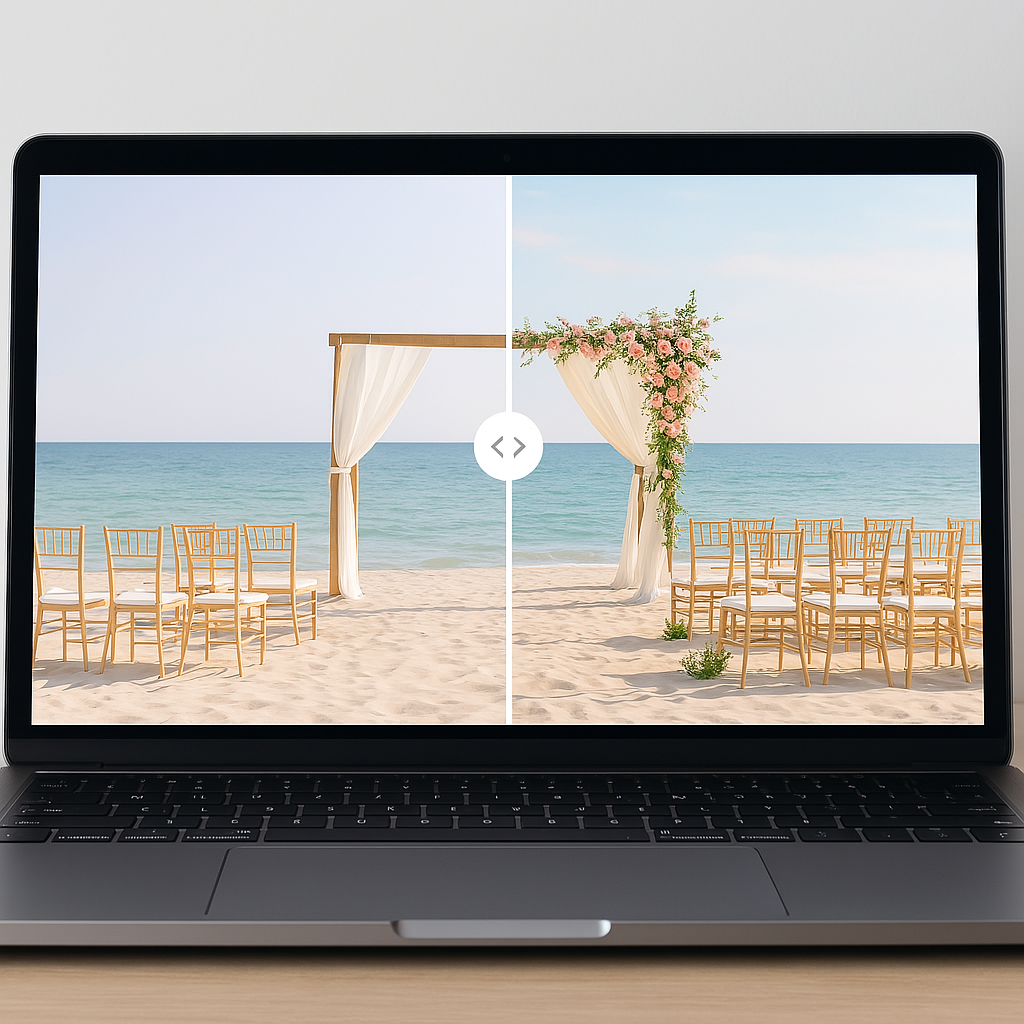
The modern wedding planning process is broken. It suffers from a fundamental "Visualization Gap." You spend hours collecting data in the form of Pinterest pins and Instagram saves. You spend thousands of dollars securing a venue. Yet there is a complete disconnect between that inspiration data and the physical reality of the space you have booked. You are asked to make high-stakes financial decisions based on imagination alone.
This gap drives what I call "Expectation Inflation." You have a vision of a modern minimalist aesthetic. Your venue is a rustic barn. Without a bridge to connect the two visuals, you risk investing in decor that clashes with the architecture. This is why 72% of couples describe planning as extremely stressful. It is not just the volume of work. It is the uncertainty of the outcome.
The solution is not more inspiration boards. The solution is VenuePreview, a purpose-built part of the modern wedding tech stack. We use artificial intelligence to bridge the visualization gap. By applying your specific style and colors to photos of your actual venue, we transform uncertainty into data. You can see how our visualization engine works to instantly validate your design choices before you spend a single dollar on florists or rentals.
The Unit Economics of Visualization Anxiety
To understand why Wedding Venue AI is becoming a critical layer in the planning stack, we need to look at the costs of the current alternatives. The wedding industry has traditionally offered two ways to visualize a space. Both are inefficient.
The first is the "Physical Mockup." You pay for florals, rentals, and labor to set up a sample table. The cost is high. Data indicates that physical staging can cost over $1,200 for a single setup. This approach has high fidelity but low flexibility. You cannot iterate. If you don't like the result, you have burned budget without solving the problem.
The second is "Professional Rendering." You hire a 3D artist to build a digital model of your venue. This solves the flexibility problem but introduces a latency problem. Market pricing for 3D rendering ranges from $800 to over $10,000, with turnaround times measured in weeks. In a market where venues book up 18 months in advance, this latency is a competitive disadvantage.
The Visualization Gap
This leaves most couples in the "Visualization Gap." They rely on imagination and generic photos. This leads to three specific failure modes in planning:
- The Scale Fallacy: Couples underestimate the volume of decor needed to fill a ballroom or overestimate what fits in a garden.
- The Lighting Misalignment: A mood board looks perfect in daylight but fails completely under venue lighting conditions.
- The Style Clash: Modern decor elements are purchased for a venue with strong historical architecture, creating visual dissonance.
The data supports this anxiety. Reports from 2025 indicate that the stress of wedding planning now rivals major life events like job hunting. A significant portion of this stress comes from the inability to "see" the end product.
Categorizing the Wedding AI Stack
Artificial Intelligence in wedding planning is not a monolith. It consists of distinct layers, each solving a different optimization problem. To understand where venue visualization fits, we must map the landscape.
1. The Administrative Layer
Tools in this category handle the "math" of weddings. They optimize guest lists, generate timelines, and draft emails. They reduce administrative friction. This is where 63% of couples feel most comfortable using AI. They want help with logistics, not emotions.
2. The Discovery Layer
These are venue finders and comparison engines. They aggregate data to match budget and capacity. They solve the "search" problem but not the "selection" problem.
3. The Spatial Layer
Platforms like Prismm (formerly AllSeated) operate here. They focus on floor plans and table layouts. These are powerful B2B tools for venue managers to ensure chairs fit in the room. They are logistical, not aesthetic.
4. The Visualization Layer (Our Focus)
This is the newest and most critical layer for design decision-making. This is where VenuePreview operates. Unlike generic image generators that hallucinate new buildings, this category focuses on contextual realism. It takes the existing constraints of a venue (walls, windows, lighting) and overlays aesthetic data (style, color, decor).
The distinction is vital. A generic AI tool might generate a beautiful wedding reception in a cathedral that does not exist. That is art. A wedding venue AI tool generates your reception in your booked venue. That is a plan.
How VenuePreview Solves the Visualization Problem
We built VenuePreview to function as a decision support engine. The product architecture is designed to minimize input friction while maximizing output fidelity. It follows a linear "Upload-Transform-Analyze" workflow.
Step 1: Ingesting Venue Data (Upload)
The system accepts 1 to 3 photos of your venue. These can be professional marketing shots from the venue's website or iPhone photos you took during a site tour. The AI model analyzes the architectural geometry. It identifies floor planes, ceiling heights, and light sources. This ensures that the generated decor respects the laws of physics and the boundaries of the room.
Step 2: Parameter Selection (Style & Color)
You define the aesthetic parameters. We do not use vague prompts. You select from structured style templates—Boho, Modern Minimalist, Black-Tie, or Rustic. You then input your specific hex codes for bridesmaid dresses or floral palettes. This aligns the output with your actual wedding color scheme.
Step 3: Generative Iteration
The engine generates 40 to 200 variations depending on your package. This high volume is intentional. In product design, we know that the first idea is rarely the best. By generating volume, you can explore edge cases. What does the room look like with heavy floral installations versus minimal greenery? How does the ambience shift from daylight to candlelight?
Step 4: Analysis and Distribution
The final output is a set of photorealistic images. These are not just for you. They become communication assets. You send them to your planner, florist, and rental company. Instead of saying "I want a romantic vibe," you show them an image and say, "Execute this." This reduces the feedback loop and eliminates ambiguity.
The Cost-Benefit Analysis of AI Visualization
When evaluating wedding venue AI tools, you must look at the ROI. The cost of a mistake in wedding decor is high. If you order $3,000 worth of tall centerpieces that block the view in a room with low ceilings, that capital is lost.
We have structured VenuePreview pricing to be a fraction of the cost of a single physical sample.
| Package Tier | Cost | Output Volume | Strategic Use Case |
|---|---|---|---|
| Basic | $19 | 40 Visualizations | Validation. You have a venue and a style. You need a sanity check to confirm they match before booking vendors. |
| Premium | $29 | 100 Visualizations | Exploration. You are deciding between two distinct styles. You need to A/B test a "Modern" look vs. a "Classic" look. |
| Luxury | $49 | 200 Visualizations | Comparison. You are comparing multiple venues. You visualize both spaces fully decorated to see which offers the highest potential. |
Compare this to the market. A single professional rendering costs 20x the price of our Luxury package. A physical mockup costs 25x. The efficiency gains are order-of-magnitude improvements.
Accelerating Decision Velocity
The primary value of VenuePreview is not just pretty pictures. It is speed. In 2026, the wedding market is competitive. Venues and vendors have limited inventory. Decision latency—the time it takes you to commit—can cost you your preferred date or vendor.
1. Eliminating Visualization Anxiety
Data from 2025 indicates that "visualization anxiety" is a primary driver of decision paralysis. Couples stall because they are afraid of making the wrong choice. By providing a visual confirmation, we remove the fear factor. You move from "I hope this works" to "I know this works."
2. The Vendor Communication Protocol
Language is imprecise. "Moody lighting" means different things to a lighting technician, a photographer, and a bride. Images are absolute. When you use VenuePreview to generate a visual reference, you create a single source of truth. You can share these images directly from your dashboard. This aligns expectations instantly.
3. A/B Testing Venues
If you are undecided between two venues, the raw space can be misleading. A darker, older venue might actually look better with your specific decor style than a bright, modern box. By running photos of both venues through the visualization engine, you can normalize the comparison. You judge them based on their potential, not their current state.
Market Landscape: Why Generic AI Fails
You might ask why you cannot simply use a generic tool like Midjourney or ChatGPT for this. The answer lies in "Hallucination vs. Constraint."
Generic AI models are trained on the open internet. If you ask for a "wedding reception in a barn," they generate a composite image of thousands of barns. They change the windows. They move the doors. They invent ceiling beams that do not exist.
If you show that image to a florist, they will design for a room that does not exist.
VenuePreview is built on a constraint-based architecture. We prioritize the preservation of the source image's geometry.
- Generic AI: High artistic flair, zero architectural fidelity.
- 3D Rendering: High fidelity, high cost, low speed.
- VenuePreview: High architectural fidelity, low cost, high speed.
We are not trying to create art. We are creating a planning document.
Addressing the Skeptics: Safety and Logistics
It is important to address the limitations of AI. Wedding venue AI is a visualization tool, not a structural engineer.
Professional florists rightly point out that AI might visualize a hanging floral installation that the venue's ceiling cannot support. Industry experts emphasize that AI concepts must always be vetted for safety and logistics.
We agree. Our tool shows you what is aesthetically possible. It is up to your human vendors to determine what is structurally and logistically executable. This is why we position VenuePreview as a communication layer. You generate the vision, then you hand it to the professionals to validate the execution. It complements the human expert; it does not replace them.
Frequently Asked Questions
Can I upload my own photos?
Yes. This is the core function. You can use professional photos from the venue's website or casual photos from your phone. The AI works best with clear, well-lit images that show the full scope of the room.
Will the AI change my venue's architecture?
Our algorithms are tuned to preserve the structural integrity of the room. We add decor into the space. We do not rebuild the space. However, minor artifacts can occur, which is why we provide 40+ variations to ensure you get multiple accurate angles.
Is this a replacement for a wedding planner?
No. A planner manages logistics, contracts, and crises. VenuePreview manages vision. In fact, planners often use our tool to help their clients articulate what they want. It makes the planner's job easier by removing the guesswork from design meetings.
How accurate are the colors?
You input specific hex codes, and the AI maps them to the decor elements. While monitor calibration and lighting engines vary, the relative color harmony is highly accurate. It is far superior to guessing how a "Dusty Rose" napkin will look against a "Mahogany" table.
The Path to a Stress-Free Wedding Plan
The era of blind wedding planning is over. You do not need to rely on imagination or expensive mockups to make decisions. The technology now exists to visualize the outcome before you commit the capital.
This is about risk reduction. It is about communication. It is about taking the most expensive party you will ever throw and applying the same level of rigor you would apply to a business project.
By using VenuePreview, you are building a modern wedding toolkit. You are moving from a state of anxiety to a state of authority. You can walk into a vendor meeting with clear visuals, validated ideas, and the confidence that comes from seeing the future of your event.
Don't just plan your wedding. Visualize it. Prove it. Then execute it.
Start visualizing your venue today for just $19 or browse our gallery of transformations to see what is possible.
Ready to Visualize Your Wedding Venue?
See exactly how your venue will look on your wedding day with AI-powered visualizations. Get started in minutes with packages starting at just $19.