Top Wedding Planning Apps to Use in 2026 for a Flawless Day
Planning a modern event requires treating the process as a complex project management exercise. The days of relying on heavy physical binders and fragmented email threads are over. Couples today are managing vendor networks, complex timelines, and significant capital outlays entirely from their smartphones.
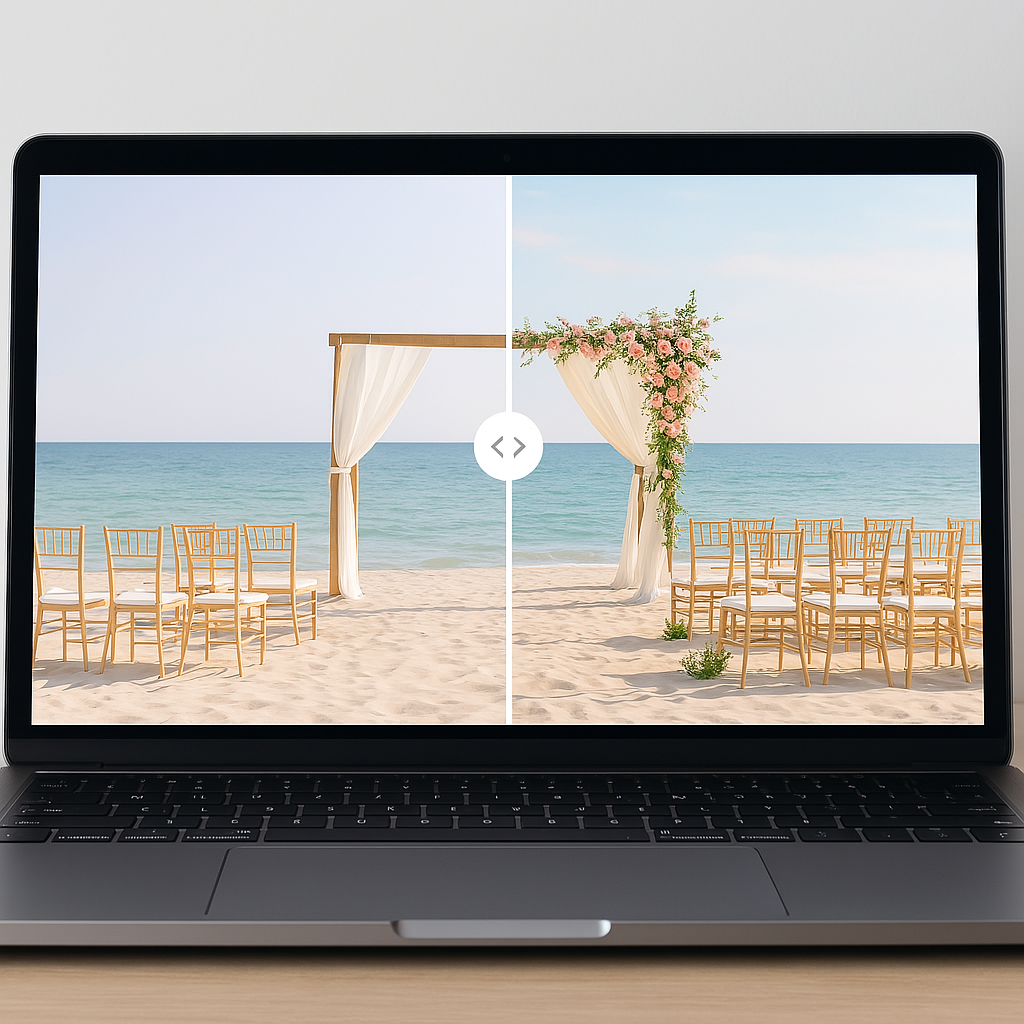
To build a functional planning system, you need logistics tools paired with specialized visualization software. A critical piece of this modern stack is our proprietary AI tool, VenuePreview. By allowing you to discover how you can solve décor visualization before spending a dime, this platform acts as the visual source of truth for your entire event.
In 2026, the goal is not to find a single perfect application. The objective is to assemble a tightly integrated "app stack" that handles checklists, budgeting, and photorealistic design. When you combine rigorous organizational tools with advanced AI visualization, you eliminate the guesswork that causes planning fatigue.
Why Wedding Planning Apps Matter More Than Ever in 2026
How wedding planning moved almost entirely online
The fundamental mechanics of event organization have undergone a structural shift. Data from 2024 shows that 90% of wedding planning now happens online, relying heavily on mobile applications and cloud-based collaborative tools. Couples are no longer constrained by geography or physical meetings.
This digital transition makes sense when you look at the scale of the operation. Couples are actively managing complex, high-cost projects directly from their phones. With average budgets ranging from $25K to $75K, the stakes demand enterprise-grade organization.
The industry has moved decisively away from paper checklists and physical fabric swatches. In their place, we see the adoption of digital dashboards, real-time shared documents, and advanced visual rendering tools. This infrastructure allows for rapid decision-making and better vendor alignment.
Common planning pain points couples keep mentioning
Despite the proliferation of digital tools, systemic friction still exists in the planning lifecycle. If you analyze recent user sentiment across forums and social platforms, specific patterns emerge. Couples consistently report feeling overwhelmed by unstructured to-do lists, leading to confusion about proper sequencing and scattered vendor information.
Budget anxiety is another recurring theme. Tracking granular vendor quotes, deposit schedules, and final payments across disparate channels causes significant stress. When financial data is fragmented across email threads, calendar reminders, and disconnected apps, mistakes happen.
The most critical gap is visual uncertainty. Even when couples have perfectly organized spreadsheets, they still struggle to visualize how their specific venue and chosen décor will actually look on the day of the event. Spreadsheets manage numbers, but they fail to capture spatial reality.
Why no single "perfect app" covers everything
A common mistake in software adoption is searching for a monolithic solution. Industry analysts and competitor data confirm a fundamental truth: there is no one perfect wedding app. The vast majority of couples end up operating two or three distinct tools in tandem.
Different applications specialize in different operational layers. Some excel at chronological checklists and vendor discovery. Others are optimized for guest list management or visual inspiration. Expecting a single platform to be world-class at both database management and photorealistic rendering is unrealistic.
The optimal strategy is building a smart, layered app stack. In this model, logistics applications handle task management and financial tracking. A separate, specialized tool is then deployed specifically for architectural and décor visualization.
How the right app stack leads to a more relaxed wedding
Systematizing your workflow fundamentally reduces decision fatigue. When you use the right mix of specialized applications, both partners maintain operational alignment. This transparency limits last-minute chaos and prevents duplicate work.
Gaining visual clarity in tandem with solid logistics creates a predictable planning pipeline. Couples can shift their focus away from constant micro-decisions and redirect that energy toward the actual celebration. Confidence comes from knowing your systems are reliable.
The goal of this guide is to help you select the most effective 2026 applications for each specific job in your workflow. We will break down the top tools for logistics, communication, and introduce a dedicated solution for absolute venue and décor clarity.
Core Wedding Planning Apps for Checklists, Budgets, and Guest Lists
All-in-one planning dashboards (The Knot, Zola, Joy, WedSites)
The foundational layer of most planning stacks is the all-in-one dashboard. Platforms like The Knot, Zola, Joy, and WedSites dominate this category. These tools typically feature customizable timelines, basic budget trackers, embedded vendor marketplaces, and consumer-facing wedding websites with integrated RSVPs.
These platforms act as a primary system of record. They excel at defining the "what to do next" sequence and keeping couples anchored to structured timelines. Their core strength lies in aggregating guest data, registry links, and event logistics into a single accessible portal.
However, utility comes with trade-offs. The primary drawback discussed in recent user cohorts is interface bloat. Because these applications attempt to serve every possible need, their dashboards can feel heavy or overwhelming for couples who prefer minimalist workflows.
Vendor discovery apps (WeddingWire, Zola, others)
Sourcing reliable vendors requires specialized market networks. Applications like WeddingWire focus heavily on localized vendor reviews, portfolio aggregation, and pricing transparency. This density of data is highly effective during the initial vetting phase.
Zola also competes heavily in this space. While it emphasizes the end-guest experience and retail registries, it simultaneously operates a robust venue discovery and planning dashboard. Market behavior data from 2025 indicates that couples frequently begin browsing these directories months before a formal proposal even occurs.
It is important to understand the limitations of these discovery tools. While they are excellent for finding physical spaces and service providers, they rely on static, historical imagery. They do not allow couples to visualize custom décor or personalized layouts within a prospective venue.
Budget and expense tracking tools (native and DIY)
Financial discipline is the constraint that dictates all other planning variables. Built-in budget features inside platforms like Zola allow couples to track pending payments against completed transactions. They offer a baseline level of organizational structure for vendor payment schedules.
Yet, a large segment of the market prefers granular control. Insights from productivity forums reveal that many couples still rely on Google Sheets or Excel. The DIY approach offers infinite customization, cross-tab organization, and the ability to build complex cost projection models.
The primary friction point of the DIY method is manual setup and the absence of industry-specific prompts. Regardless of whether you use native app trackers or custom spreadsheets, a fundamental gap remains. Budget tracking answers where the money goes, but it cannot answer what that money will actually look like on the event day.
Guest list, RSVP, and website tools
Communication infrastructure is the next essential layer. Managing attendees requires tools capable of formatting guest lists, processing digital RSVPs, organizing complex meal selections, and broadcasting event details. This is primarily handled through personalized event websites.
Newer market entrants focus heavily on user experience. Applications like Joy and WedSites prioritize clean design architecture and mobile-first interactions for the end guest. They reduce the friction of collecting mailing addresses and managing plus-one allocations.
These platforms are highly optimized for data collection and communication. They do not, however, cross over into spatial or aesthetic planning. To build a complete system, couples need elite guest management paired with a dedicated tool that validates how their chosen venue will look and feel.
Support Apps: Visual Inspiration, Notes, and Collaboration
Inspiration and mood board apps (Pinterest and Canva-style tools)
Every creative project begins with an aggregation phase. Couples rely heavily on inspiration platforms to curate decor themes, floral concepts, and color palettes. Pinterest and Canva-style interface tools are the industry standard for creating collaborative mood boards.
These platforms provide an infinite scroll of visual data. They support creative brainstorming by allowing users to quickly save and categorize aesthetics that resonate with their vision. Mood boards are an excellent first step in defining a high-level creative direction.
The critical limitation of these tools is context. Inspiration images are inherently disjointed. A beautiful floral arch shot in a California vineyard does not translate linearly to a modern hotel ballroom in New York. Mood boards spark ideas, but they fail to prove how those ideas will function in a specific physical environment.
DIY organization tools (Google Sheets, Notion, shared email)
For couples managing complex logistics, standard consumer apps often lack flexibility. This drives adoption of modular productivity software. Google Sheets is frequently deployed to build custom operational checklists, master budget models, and vendor tracking matrices.
Notion has also gained significant traction as an event wiki. It allows couples to consolidate checklists, PDF contracts, vendor conversations, and hyperlinked inspiration into one shared workspace. Pairing these tools with a dedicated, shared Gmail account ensures vendor communication remains searchable and isolated from personal inboxes.
These systems are highly flexible and incredibly cost-effective. The trade-off is the high cognitive load required to build and maintain them. They require upfront architectural thinking and lack native wedding-specific intelligence to guide the user.
Photo and memory tools (Once, shared drives, albums)
Content capture is a distinct operational category. Applications like Once function as digital disposable cameras, allowing guests to actively participate in event documentation. They leverage the crowd to capture candid moments that official photographers might miss.
Shared cloud infrastructure is another common solution. Couples frequently provision Google Drive or Dropbox folders, generating QR codes to prompt guests to upload raw photo files during the reception.
It is vital to categorize these applications correctly. They are post-event memory capture tools, not pre-event planning systems. They serve an entirely different function than predictive visualization platforms designed to assist in architectural and décor planning.
Where traditional venue and décor planning still falls short
When you analyze the standard app stack, a significant capability gap becomes obvious. Even with structured checklists, dense inspiration boards, and comprehensive vendor networks, couples operate blind. They cannot truly "see" their decorated venue in advance.
This visualization gap is the primary driver of planning anxiety. Trying to mentally synthesize how rented linens, floral centerpieces, uplighting, and table layouts will interact within a specific, usually empty space is incredibly difficult. Most human brains struggle with accurate spatial rendering.
Venue tours compound the problem. Spaces are usually shown completely bare or styled for an event with a vastly different aesthetic. This leaves couples guessing how their specific capital investment will look. New visual tools driven by artificial intelligence have emerged precisely to close this gap.
Layout, Floor Plan, and Décor Visualization Tools in 2026
Floor plan and seating chart apps
Spatial logistics require dedicated software. Drag-and-drop seating chart and floor plan generators have become standard features within modern venue-focused applications. These tools are critical for defining the physical footprint of the event.
By allowing couples to map out tables, stage placements, and dance floors to scale, these applications ensure proper traffic flow. They prevent overcrowding and optimize the physical guest experience based on the room's precise dimensions.
However, floor plan software provides a top-down, schematic view. It is an engineering tool, not a design tool. It excels at spatial logistics but fundamentally fails to answer aesthetic questions. It cannot tell you if a specific color palette will look too dark against the venue's natural lighting.
Static mockups and 3D rendering services
Historically, bridging the gap between a schematic and reality required professional intervention. The traditional method involved hiring an event designer to build physical table mockups or commissioning a digital artist to create a scene using generic 3D software.
These legacy methods come with severe trade-offs. Physical mockups carry high capital costs and require physical travel. Traditional 3D rendering suffers from long turnaround times and offers limited ability to explore alternative style variations without triggering costly revision fees.
Furthermore, generic 3D renderings often fail to capture the specific architectural nuances of the actual venue. They are approximations. For couples planning on standard timelines, these options are typically out of reach, too slow, or lack the necessary realism to drive confident decisions.
Why couples are asking for better décor visualization
Market demand for better visualization tools is accelerating. Qualitative data from user forums highlights a recurring desire to "see it before we commit." When dealing with rentals, florals, and custom linens, commitment requires upfront capital.
Décor choices easily represent thousands of dollars in expenditure. Relying on guesswork across budgets of $25K to $75K is fundamentally poor risk management. Couples are demanding tools that provide visual certainty before contracts are signed.
Specific anxieties dominate the planning cycle. Couples worry about mixing complementary colors incorrectly. They fear choosing linens that clash with the venue's existing carpets or drastically underestimating the required lighting design. An AI-powered visualization layer that uses actual venue photography solves this specific problem.
Where AI fits into modern wedding planning stacks
Artificial intelligence is already optimizing standard planning tools through smart checklists and vendor recommendation algorithms. In 2026, the technology has advanced into the realm of spatial rendering and visual planning.
AI venue visualization is the natural companion to traditional logistics software. It creates a complete triad: project management, financial tracking, and photorealistic décor previews. This combination creates an airtight planning system.
This context sets the stage for our proprietary tool. VenuePreview operates as a highly focused, AI-driven solution engineered specifically to eliminate visualization anxiety. It does not replace your core planning dashboard. It acts as an essential complementary layer that makes your entire stack more effective.
Meet VenuePreview: The AI Wedding Venue Visualization App for 2026
What VenuePreview is (and what it isn't)
VenuePreview is an advanced AI-powered wedding venue visualization service. It is designed to take standard photos of empty or undecorated venues and mathematically transform them into fully decorated, photorealistic scenes based on your precise aesthetic inputs.
Product positioning is critical. VenuePreview is explicitly focused on venue and décor visualization. It is not a generic photo manipulation tool. It is not an all-in-one wedding management dashboard designed to track guest meals or vendor invoices.
We also do not operate as a virtual reality walkthrough tool. VenuePreview is a specialized visualization layer built to deliver high-fidelity still images. The core promise is absolute clarity: it allows couples to see their specific venue exactly as it will look before a single dollar is spent on décor or rentals.
How VenuePreview works step-by-step
The user experience is engineered for maximum output with minimal friction. The workflow begins with a simple upload sequence. Couples provide one to three photos of their venue in its empty or baseline state directly into our web application.
The next phase is aesthetic selection. Users navigate our curated library to choose specific style templates, color schemes, and lighting preferences that align with their overall vision. This data parameters the AI model.
Upon execution, VenuePreview's custom architecture generates between 40 and 200 distinct, photorealistic visualizations. This processing is highly efficient. Final images are delivered within 10 to 25 minutes, allowing users to immediately browse, filter, and download their preferred renderings for vendor distribution.
Key features designed for engaged couples and planners
The platform is built around four core capabilities designed to accelerate the planning cycle.
- AI Venue Visualization: The engine transforms raw, real-world venue photography into highly accurate, dream wedding environments in minutes.
- Multiple Style Variations: Depending on your selected tier, the system outputs 40 to 200 unique visual variations. This allows you to aggressively test different lighting setups, floral densities, and color palettes.
- Fast Delivery: Speed enables iteration. The 10 to 25 minute turnaround time means you can test a design hypothesis, review the results, and pivot immediately if the aesthetic fails to meet expectations.
- Enhanced Communication Tools: Integrated downloading and sharing features allow you to distribute visual proof directly to planners, florists, and rental companies. This forces immediate vendor alignment.
Who VenuePreview is perfect for
The tool is built primarily for engaged couples operating 3 to 12 months out from their event date. It serves those who require definitive visual clarity before locking in non-refundable décor commitments. If you want to leverage the VenuePreview wedding venue visualization service to validate your ideas, this is the optimal window.
It is highly effective for events operating with middle to high budgets, where décor decisions represent a significant percentage of total spend. It is also an incredibly powerful tool for couples in the early stages of planning who are struggling to choose between multiple empty venues.
Beyond the end consumer, the platform provides immense leverage for industry professionals. Wedding planners, event designers, and venue coordinators use VenuePreview to establish clear visual reference points that guide their clients away from bad decisions and toward actionable execution.
VenuePreview Pricing, Packages, and Real Planning Benefits
Clear, one-time pricing tiers for every budget
Software pricing should be transparent and tied directly to value. VenuePreview operates strictly as a direct-to-consumer service with straightforward, one-time purchase packages. We intentionally avoid the ongoing subscription models that plague modern software.
The Basic package is priced at $19. It delivers 40 unique visualizations across two style variations, with our standard 10 to 25 minute delivery SLA and email support. It is the perfect entry point for testing initial concepts.
The Premium package is priced at $29. It scales output to 100 visualizations and unlocks five style variations. It also introduces priority support and advanced vendor sharing features. For maximum personalization, the Luxury package at $49 delivers 200 visualizations, ten style variations, and access to highly customized aesthetic inputs.
How VenuePreview saves money and reduces décor risk
Using software to visualize outcomes before allocating capital is an asymmetric bet. VenuePreview acts as an insurance policy against costly aesthetic mistakes. You secure visual certainty before you spend thousands on rentals, custom fabrication, or high-volume florals.
When you can see dozens of style options rendered side by side in your actual venue, impulse purchases plummet. You realize immediately that the expensive velvet linens you wanted clash with the venue's natural lighting. You can compare VenuePreview packages for your wedding to find the exact level of rendering volume needed to de-risk your budget.
Compared to legacy solutions, the return on investment is massive. Physical mockups cost hundreds of dollars and require significant travel time. VenuePreview delivers superior, varied visual data at a fraction of the cost and in a fraction of the time.
Turning inspiration boards into venue-specific visuals
Abstract inspiration is only valuable if it can be contextualized. VenuePreview allows couples to extract concepts from their Pinterest boards and immediately translate them into the architecture of their actual venue.
The process shifts the planning narrative from theoretical to concrete. Instead of guessing how a Tuscan floral theme will look in a domestic barn, you generate a photorealistic view of that exact synthesis. This transition from abstract mood board to concrete visualization is the ultimate driver of planning confidence.
This capability is particularly crucial for outdoor or non-traditional spaces. Variables like ambient lighting, seasonal foliage, and structural constraints are notoriously difficult to imagine from static inspiration photos. AI rendering solves this calculation instantly.
Using VenuePreview alongside your existing wedding apps
Integration is the key to a successful tech stack. VenuePreview is designed to slot perfectly into your existing workflow. A highly optimized 2026 stack consists of an all-in-one planner for database management, a spreadsheet for granular budgeting, and VenuePreview for absolute décor clarity.
The practical application is simple. Generate your images in VenuePreview, export the files, and attach them directly to your vendor email threads and shared Google Drive folders. This establishes a definitive visual baseline that prevents miscommunication.
Professional planners integrate VenuePreview renderings directly into their client presentation decks. It allows them to quickly secure approvals on creative direction. VenuePreview does not replace your logistical apps. It fills the critical visualization void, making every subsequent decision faster and safer.
How to Choose the Right 2026 Wedding Apps for Your Day (and Next Steps)
Match apps to stages of your planning journey
Strategic sequencing prevents tool fatigue. Your app stack should evolve as your project moves through its lifecycle. Begin with inspiration platforms and basic budget frameworks. Once capital is defined, transition into vendor discovery and venue selection.
When the physical location is secured, deploy your logistics tools and visualization software simultaneously. Use all-in-one applications to build out the database, use DIY tools to track granular variables, and leverage VenuePreview to finalize the aesthetic roadmap before signing rental contracts.
Do not adopt tools indiscriminately. Select software that you and your partner will actively maintain. Consistency and operational clarity are far more valuable than possessing a dozen fragmented apps.
Questions to ask when choosing any wedding planning app
Evaluating software requires a rigorous framework. Do not get distracted by marketing copy. Assess each application based on feature density, cross-device compatibility, UI friction, and multi-user collaboration capabilities.
Add a mandatory new criterion to your evaluation matrix. Ask yourself: does this application actually help me see the physical reality of my event, or does it only manage lists and numbers? If it only manages data, you have a visualization gap.
Always validate tools before committing data to them. Test free versions and demo environments to ensure the interface aligns with your workflow. Consider the interoperability of the tool. If an application cannot easily export data to your shared drives or email clients, it is a silo, not a solution.
Why VenuePreview is the smart final layer for a flawless day
Building a reliable planning system is about eliminating variance. VenuePreview acts as the final, most critical layer of your operational stack. It takes the abstract concept of an empty room and mathematically renders your definitive vision.
The core value proposition is straightforward. We eliminate visualization anxiety, accelerate your decision-making velocity, and protect your budget from expensive, avoidable design errors.
Our competitive differentiation is rooted in speed and accuracy. We operate at a lower cost and faster turnaround time than physical staging, while delivering results that are significantly more tailored than generic 3D modeling. VenuePreview is the intelligent leverage that makes the rest of your app stack operate flawlessly.
Next steps: start visualizing your venue today
The path to absolute clarity requires immediate action. Do not wait until vendor deadlines force hasty decisions. Identify one to three high-quality photos of your venue in its baseline, undecorated state.
Evaluate your timeline and budget, then select the VenuePreview package that matches your required variation density. Whether you choose Basic, Premium, or Luxury, the return on investment is immediate visual certainty. Take the output and distribute it to your vendor network to establish immediate alignment.
The technology exists to eliminate guesswork from your event execution. Take control of the visual outcome right now. Start visualizing your venue and discover exactly how your space will look fully decorated.
Ready to Visualize Your Wedding Venue?
See exactly how your venue will look on your wedding day with AI-powered visualizations. Get started in minutes with packages starting at just $19.