Best Apps for Wedding Venues in 2026: Planning, Management & Visualization
The digital transformation of the wedding industry is not coming. It has already happened.
In 2024, data from The Knot's analysis of nearly 17,000 couples showed that 90% of all wedding planning now occurs online. The modern engagement period is no longer defined by binders and physical swatches. It is defined by a sophisticated stack of mobile applications, cloud-based spreadsheets, and vendor marketplaces. Couples are now managing a project with an average cost exceeding $33,000 entirely from their devices.
However, a critical friction point remains in this digital ecosystem. While apps for logistics, guest lists, and vendor discovery have matured, there is a significant "visualization gap." Couples can book a venue and hire a florist online, but they struggle to understand what those two decisions will look like when combined. This is where VenuePreview enters the stack. As a key part of the modern wedding tech toolkit, our platform uses AI to see how our platform works and bridge the gap between abstract planning and visual reality.
This article analyzes the current landscape of apps for wedding venues. We will break down the essential tools for logistics and management, identify where traditional apps fall short, and explain how new visualization technology is solving the most stress-inducing problem in wedding planning.
Why Wedding Venues Need Apps Now More Than Ever
The wedding planning process has evolved from a linear, offline journey into a continuous, multi-channel digital experience. The distinction between "online" and "offline" planning has dissolved. For couples and venue owners alike, apps are no longer optional tools for efficiency. They are the primary infrastructure of the event.
Couples plan everything on their phones
The behavior of the modern couple is characterized by mobile-first, always-on planning. The average couple now spends six hours per week organizing details, often in fragmented micro-sessions across devices. Data from 2024 indicates that planning is split evenly between desktop (47%) and mobile (45%).
This shift dictates that any successful venue strategy must be mobile-accessible. Platforms like The Knot and Zola have capitalized on this by offering comprehensive ecosystems that handle everything from registries to vendor messaging. If a venue or a planning task cannot be managed via an app, it becomes a friction point that modern couples will likely avoid.
The two sides of "wedding venue apps"
When we discuss "apps for wedding venues," we are actually discussing two distinct software categories that must interoperate.
- Demand-Side Apps (Couples): These are discovery and coordination tools. Couples use them to filter venues by capacity, read reviews, and manage their budget. Their primary goal is information aggregation and decision support.
- Supply-Side Apps (Venues): These are operational tools for owners and managers. Platforms like Tripleseat focus on lead capture, contract management, and event orders. Their primary goal is conversion efficiency and operational scale.
The disconnect often occurs in the middle. The couple's app shows them static photos of an empty hall. The venue's app tracks the contract. Neither side has a tool that effectively communicates the creative vision of the event.
The visualization gap in venue planning
This disconnect creates what we call the "visualization gap." It is the single largest source of anxiety in the planning process.
According to industry research, 71% of couples do not feel prepared for the sheer number of decisions required during planning. The top descriptors for the process are "exciting" but also "stressful." The core of this stress is uncertainty. Couples are asked to commit thousands of dollars to decor and lighting based on mood boards and imagination. They cannot "see" the result until the wedding day, by which point it is too late to change course.
Apps Couples Use to Discover and Compare Wedding Venues
The discovery phase of the wedding funnel is dominated by large marketplaces. These platforms have aggregated supply and demand effectively, solving the problem of "finding" a venue.
The Knot
The Knot remains the foundational discovery engine for the US market. It functions as a massive search directory, allowing couples to filter venues by region, price, and style. Beyond discovery, it provides a suite of planning tools including checklists and budget calculators.
For couples, the value proposition is volume and social proof. They can access thousands of vendor reviews to validate their choices. For venues, it is a lead generation hose. However, the visual experience is typically limited to a gallery of past weddings, which may or may not reflect the couple's specific style.
WeddingWire & Zola
WeddingWire and Zola serve similar functions but with different emphases. WeddingWire is heavily focused on vendor reviews and detailed pricing transparency. It is often used in the vetting phase.
Zola has carved out significant market share by focusing on the user experience of the guest and the registry. Their planning dashboard integrates venue discovery with website building. Data from 2025 shows that 100% of couples now take at least one planning step, such as browsing venues on these apps, before the proposal even happens. This "pre-planning" behavior makes digital presence critical for venues.
Joy & Other Wedding Planning Apps
Joy represents the newer wave of planning apps that prioritize aesthetic design and mobile UX. While originally focused on websites and guest lists, Joy has expanded into inventory and registry management. These apps excel at the logistical layer of planning (who is coming, where are they staying), but they generally rely on external links or static images for the venue selection process.
Apps for Wedding Venue Layouts and Floor Plans
Once a venue is booked, the focus shifts to spatial planning. This is where the app stack moves from discovery to logistics.
Floor Plan & Seating Chart Apps
Tools like Aisle Planner and specialized seating chart applications allow couples and planners to map out the physical flow of the event. They address the question: "Will the tables fit?"
These tools are essential for operations. They prevent overcrowding and ensure service paths are clear. However, they are typically 2D, top-down schematic tools. They solve for capacity, not atmosphere. A couple looking at a 2D circle representing a table cannot visualize how their chosen centerpieces will interact with the venue's lighting.
Color Palette & Design Inspiration Apps
For aesthetic planning, the market leader is undeniable. Pinterest is the primary inspiration source for 77% of couples. It acts as the visual database for the wedding industry.
The "Pinterest-to-purchase pipeline" is a well-documented phenomenon. Couples curate boards for years, establishing a strong aesthetic preference. The challenge arises when they attempt to map these curated, professional photos onto their specific venue. A rustic barn wedding on Pinterest looks different than a rustic theme in a hotel ballroom. Pinterest provides inspiration, but it does not provide venue-specific validation.
Wedding Venue Management Software for Owners & Planners
On the business side of the transaction, venue owners utilize a different set of tools designed for Customer Relationship Management (CRM) and operations.
Tripleseat and Similar Venue CRMs
Tripleseat is the dominant player in venue management, utilized by over 19,000 venues globally. It streamlines the inquiry-to-booking pipeline, handles electronic signatures, and manages banquet event orders.
For a venue owner, this software is the operating system of the business. It organizes the chaos of hundreds of inquiries. It allows for the creation of floor plans to show prospects potential layouts.
Limitations of traditional venue management apps
While excellent for operations, these CRMs often fail as sales enablement tools for the creative side of the wedding. They are designed to sell the space (capacity, availability, price), not the vision.
Many venues still rely on showing prospects photo galleries of weddings from three years ago to help them visualize the potential. If a couple wants a "modern goth" aesthetic but the venue only has photos of "rustic chic" weddings, the venue manager has no tool to bridge that gap. This is where deals are lost.
The Missing Piece: Apps to Visualize Your Wedding Venue Decor
The current stack has a hole. We have apps to find venues, apps to map floor plans, and apps to sign contracts. We lack accessible apps that show the couple their wedding in their venue.
Why visualization matters for couples
"Visualization anxiety" is a specific form of decision paralysis. Couples are expected to allocate roughly 9% of their budget to florals and decor. On a $33,000 budget, that is nearly $3,000 spent on a visual product they will not see until the day of the event.
This anxiety leads to "safe" choices. Couples default to standard white florals or minimal decor because they are afraid to take a risk on a bold color palette they cannot test. They struggle to compare styles. Without a visual reference, a "moody, candlelit dinner" is just a phrase, not a plan.
Why visualization matters for venues
For venues, this gap represents a sales inefficiency. When a prospect walks into an empty ballroom, the venue manager has to work hard to help them imagine the possibilities. If the prospect cannot see it, they are less likely to book.
Furthermore, visualization drives upsells. It is difficult to convince a client to upgrade to premium lighting or ceiling drapery using words alone. If the client can see a side-by-side comparison of the room with and without the upgrade, the value becomes self-evident.
VenuePreview: An AI-Powered Wedding Venue Visualization App
VenuePreview is designed to function as the visualization layer in the modern wedding tech stack. It is not a marketplace and it is not a CRM. It is a specialized tool that uses generative AI to solve the specific problem of visualization anxiety.
What VenuePreview Does
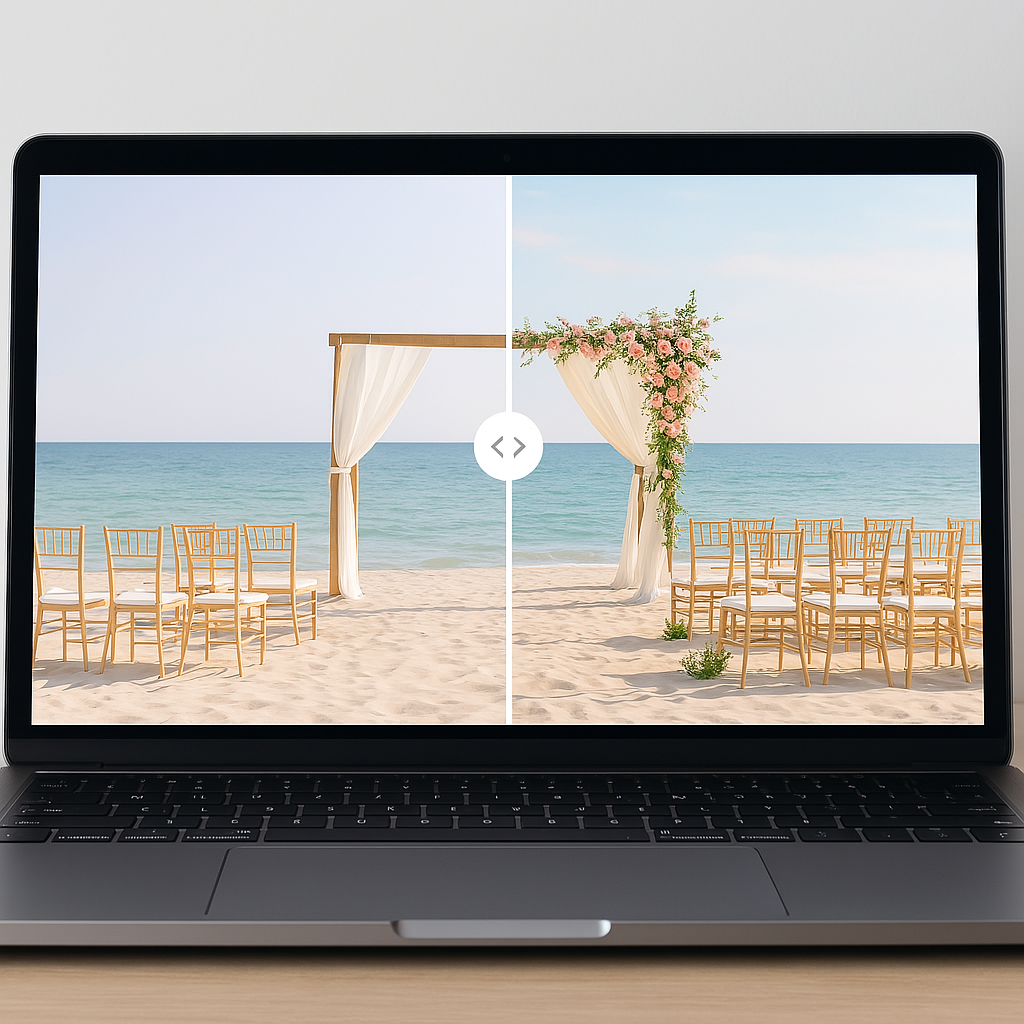
We transform photos of empty or undecorated venues into photorealistic, fully decorated visualizations. By leveraging advanced AI models, specifically adapted for spatial understanding and lighting physics, the platform takes a user's uploaded photo and applies their chosen wedding style.
The output is not a generic stock photo. It is the user's actual venue, reimagined with specific color palettes, lighting conditions, and decor themes. Users can toggle between "Boho," "Classic," "Glam," or "Modern" styles to see how different aesthetics interact with the venue's architecture.
Who VenuePreview Is For
This tool is built for the user segment most affected by visualization anxiety: engaged couples in the 3 to 12-month planning window. These couples are often managing budgets between $25,000 and $75,000, where the investment is high enough to cause stress but not high enough to hire a professional rendering artist.
It also serves venue owners and planners who want to provide a higher level of service. Instead of asking clients to "just imagine it," they can explore the wedding visualization tool to provide concrete visual examples during the sales process.
How VenuePreview Works (Step-by-Step)
We have designed the user flow to be frictionless, acknowledging that couples are already overwhelmed with decisions. The process requires no design skills or technical expertise.
1. Upload Your Venue Photos
The user begins by uploading 1 to 3 high-quality photos of the venue. These can be taken with a smartphone during a tour or downloaded from the venue's website. The system accepts indoor ballrooms, outdoor gardens, or hybrid spaces.
2. Choose Your Wedding Style & Colors
Users browse a library of pre-made visual style templates. These templates control the logic for floral density, furniture style, lighting mood, and color schemes. You select the variables that match your vision board.
3. Generate 40–200 AI Venue Visualizations
The core engine, built on GPT-4o technology, processes the spatial data of the image. It identifies the floor, ceiling, and walls, and generates new layers of decor that respect the perspective and lighting of the original photo. This process takes between 10 and 25 minutes.
4. Compare, Select, and Download Your Favorites
The user receives a gallery of 40 to 200 variations. This volume is critical. It allows couples to see "wildcard" options they might not have considered. You can download the favorites to share with your florist or planner, ensuring everyone is aligned on the visual direction.
Start visualizing your venue now: https://app.venuepreview.com/
Packages & Pricing: How Much Does Venue Visualization Cost?
In the traditional market, visualization is a luxury service. Hiring a 3D rendering artist to model a wedding venue typically costs between $2,000 and $5,000 and takes weeks. VenuePreview changes the unit economics of this process entirely.
One-Time, Affordable Packages for Couples
We operate on a one-time purchase model, respecting that a wedding is a finite project.
- Basic ($19): Perfect for a quick check. Includes 40 venue visualizations and 2 style variations.
- Premium ($29): The standard tier. Includes 100 visualizations and 5 style variations.
- Luxury ($49): For deep exploration. Includes 200 visualizations and 10 style variations.
All packages include the core delivery promise: a 10 to 25-minute turnaround time.
Why this is cheaper than traditional mockups
The alternative to digital visualization is physical mockups. A "sample table" setup with a florist often involves buying the flowers, renting the linens, and paying for the labor. This can cost hundreds of dollars for a single table. Digital visualization allows couples to test dozens of concepts for less than the cost of a single centerpiece.
How VenuePreview Fits with the Other Apps You Use
VenuePreview is not a replacement for The Knot or Tripleseat. It is a complementary layer that enhances the utility of those platforms.
Use VenuePreview with The Knot, Zola, and WeddingWire
Couples should continue to use discovery apps to find potential venues. Once a shortlist is created, VenuePreview becomes the validation tool. Before signing a contract, upload photos of the top two choices to see which space transforms better under your preferred decor style.
Use VenuePreview with Floor Plan Tools
Use a floor plan app to determine if you have space for 15 tables. Then, use VenuePreview to see what the room looks like when filled with those tables. This combines logistical accuracy with aesthetic reality.
Use VenuePreview with Pinterest and Instagram
Pinterest is for diverging (finding ideas). VenuePreview is for converging (making decisions). Take the general inspiration from a Pinterest board—"dusty blue, romantic lighting"—and apply it to the specific venue photo. This moves the couple from "I like this vibe" to "I like this venue."
Who Benefits Most from Wedding Venue Visualization Apps?
The impact of this technology extends across the entire wedding ecosystem.
Couples
The primary benefit is confidence. Visualization removes the "what if" factor. Couples with specific visions can verify that a venue supports their style. Couples without a vision can experiment rapidly to find one.
Wedding Venues
For venues, AI visualization is a powerful marketing asset. Venues can use generated images in their sales decks to show versatility. A rustic barn can be shown as an elegant black-tie venue, expanding the potential addressable market of the space.
Planners and Decor Vendors
Planners use these visuals to align expectations. It reduces the revision cycles with clients. Instead of vague feedback like "make it more romantic," a client can point to an image and say, "I want that lighting."
Choosing the Right Apps for Your Wedding Venue Planning
To navigate the modern wedding successfully, you need a curated stack of tools. You do not need every app, but you need the right ones for each phase of the journey.
A Simple App Stack for Couples
- Macro Planning: One app for overall checklists and budget (e.g., The Knot or Zola).
- Logistics: One dedicated tool for guest lists and seating charts.
- Visualization: VenuePreview to validate decor decisions and communicate vision.
A Simple App Stack for Venue Owners
- Operations: A robust CRM like Tripleseat to manage the pipeline.
- Layout: A floor plan tool for capacity planning.
- Sales Enablement: VenuePreview to help prospects visualize the potential of the space and close bookings faster.
Building Your Modern Wedding Toolkit
The era of planning a wedding based on guesswork and binders is over. The data is clear: couples are demanding digital solutions that offer transparency, efficiency, and control. While discovery and management apps have laid the foundation, visualization technology is the final piece of the puzzle. It bridges the gap between the logistical plan and the emotional experience of the event.
By integrating visualization into your planning stack, you move from hoping everything looks good to knowing it will. Whether you are a couple trying to make confident decisions or a venue looking to sell a vision, the ability to preview the future is the ultimate advantage.
Ready to actually see your wedding venue decorated before you book decor? Try VenuePreview today and get your first venue visualizations in under 25 minutes.
Ready to Visualize Your Wedding Venue?
See exactly how your venue will look on your wedding day with AI-powered visualizations. Get started in minutes with packages starting at just $19.