Airbnb Wedding for Destination Weddings in 2026: Legal, Logistics & Decor (You Can See It All Before You Book)
The modern wedding tech stack has shifted. In 2026, couples are moving away from rigid, four-hour event slots at traditional venues and toward immersive, multi-day experiences. The data supports this migration: couples want intimacy, personality, and the "whole weekend together" dynamic that only a private property can provide. However, executing this vision on platforms like Airbnb requires navigating a complex layer of platform policies, local ordinances, and logistical hurdles that most planning frameworks fail to address.
There is a significant gap between the dream of a private villa wedding and the operational reality. Reddit threads are filled with confusion regarding "party bans," photographers offer conflicting anecdotes about what hosts actually allow, and international regulations for destination weddings remain opaque. This article serves as a definitive operational guide. We will clarify the current state of platform rules, dissect the specific legal and logistical workflows for destination rentals, and introduce the necessary tooling to mitigate risk.
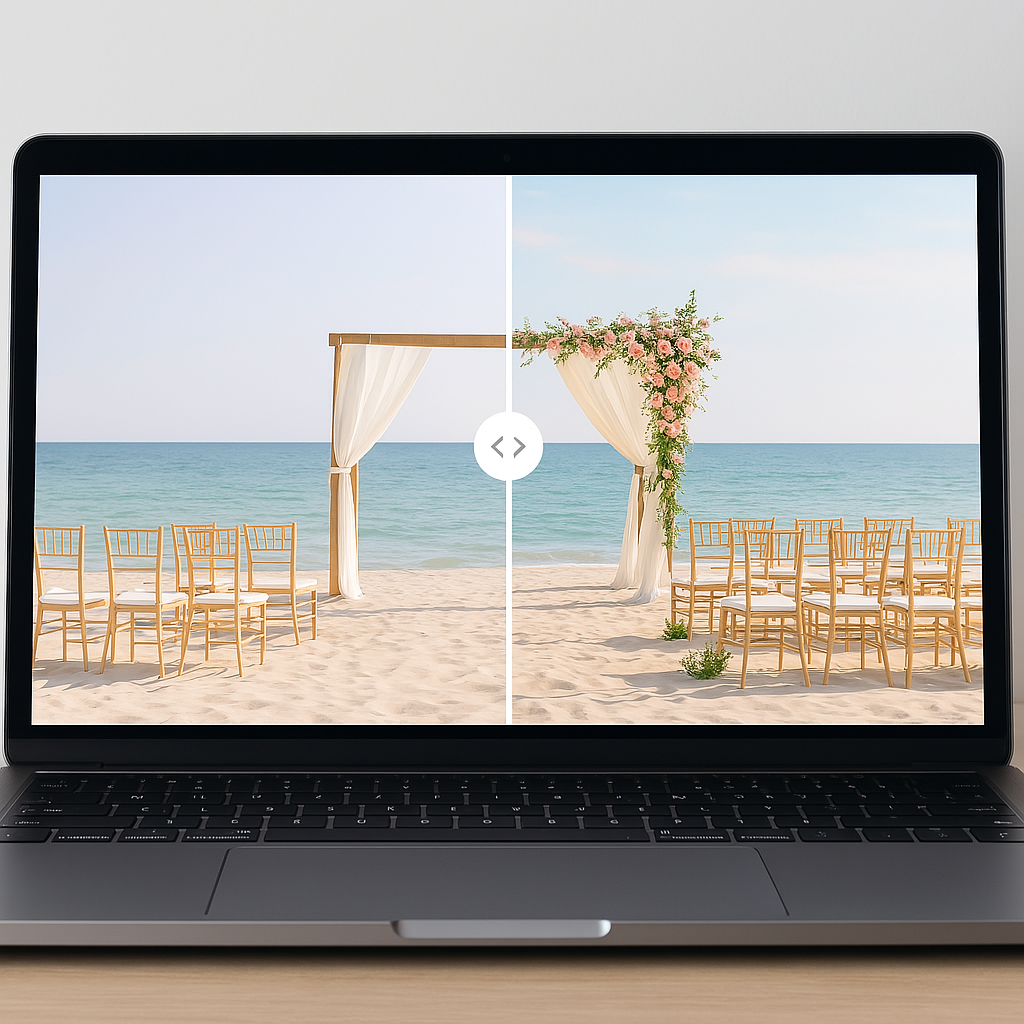
A critical component of this modern stack is visualization. The "visualization gap"—the inability to predict how a ceremony setup fits into a rental property based on wide-angle listing photos—is a primary source of budget overrun and regret. We will show you how to use see your wedding space fully decorated with VenuePreview to validate your venue choice before you sign a contract. This is not about generic advice. It is about the specific mechanics of safely planning a rental-based wedding in the current year.
Can You Really Have a Wedding at an Airbnb in 2026?
Airbnb’s Official Policy vs. Real-Life Practice
To understand the feasibility of a rental wedding, you must distinguish between platform policy and host discretion. Airbnb officially enforces a "Community Disturbance Policy" that explicitly prohibits "disruptive gatherings." This language is intentional. It replaced the platform's former "suitable for events" filter and allows the company to distance itself from liability regarding noise complaints. The policy allows the platform to suspend listings or users found to be hosting disruptive parties.
However, "disruptive" is the operative word. In practice, thousands of couples successfully host ceremonies and micro-weddings by operating within the nuance of host permissions. While the platform removed the hard 16-guest occupancy cap in 2022 to accommodate larger estates, the responsibility now lies with the host to set limits. Successful planning requires direct communication. You cannot rely on a listing's description. You must secure written permission through the messaging system or a separate contract that explicitly defines your event as a non-disruptive gathering.
When a Vacation Rental Wedding Makes Sense
The strategic decision to use a rental property should be based on your specific constraints and guest count. The vacation rental model provides a high return on experience for intimate guest lists, typically under 30 to 50 people. It is the optimal solution for couples prioritizing a natural setting over a ballroom and who are willing to manage the "infrastructure" of the event.
Conversely, a dedicated venue offers better unit economics and risk mitigation for larger guest counts. If your wedding requires strict adherence to local regulations without your direct involvement, or if you expect a guest list exceeding 50 people, the logistical complexity of a rental property—trash removal, bathroom capacity, and catering access—often outweighs the benefits of privacy.
Airbnb Wedding for Destination Weddings: Unique Pros & Cons
Why Couples Choose a Destination Airbnb Wedding
The primary value proposition of a destination Airbnb wedding is the consolidation of the guest experience. Traditional hotel blocks fragment the guest list. A large rental property keeps the core group under one roof for multiple days. This allows for a natural flow of events: a welcome dinner, a pool party, the ceremony, and a recovery brunch can all occur in a single location.
This approach also unlocks location flexibility. You are not limited to the commercial zones where hotels are built. You can access beachfront villas in Mexico, mountain cabins in Colorado, or countryside estates in Italy. This emotional value is significant; the property feels like a home rather than a commercial rental.
However, this flexibility introduces a "blind spot." You are booking a property based on photos designed to sell vacations, not events. You get a blank canvas, but you also inherit the burden of designing it. This is where tools like VenuePreview become essential. By allowing you to visualize layouts and decor in the actual space, you can confirm if the "romantic terrace" actually fits your guest count before you commit to the booking.
The Downsides & Hidden Costs You Need to Plan For
The risks of the rental model are distinct from traditional venues. The most significant is platform volatility. Hosts can cancel bookings with limited notice, often due to personal reasons or platform delisting. In October 2025, Airbnb introduced a 24-hour free cancellation window for confirmed reservations, adding another layer of uncertainty. Unlike a commercial venue with a reputation to protect, an individual host has less incentive to honor a booking if a better offer or a personal conflict arises.
Financially, the "sticker price" of a rental is misleading. You must account for the operational costs that traditional venues bundle into their fees. You become responsible for rentals, catering infrastructure, parking logistics, and waste management. Hidden costs frequently include steep cleaning fees, multi-night minimums, and vendor surcharges for remote locations. Furthermore, the "visualization gap" often leads to wasted budget. Listing photos do not show how 40 chairs fit on a deck. Without pre-visualizing the layout with VenuePreview, couples often order rentals that do not fit or fail to account for rain plans, leading to expensive last-minute pivots.
Step-by-Step: How to Plan an Airbnb Destination Wedding in 2026
Step 1 – Choose Your Destination and Guest Count First
Your planning workflow must begin with the destination and the headcount, as these variables dictate property availability. Specific regions like Greece, Mexico, or Colorado offer different inventory types. You must evaluate these locations based on flight accessibility for guests, weather seasonality, and legal marriage requirements.
Guest count is your primary constraint. Many vacation rentals cap overnight occupancy at 10 to 12 people. If you plan a wedding for 30 to 50 guests, you face a logistical split: you need a property that allows events for that number, even if everyone cannot sleep there. This often requires booking a "hub" property for the event and lodging for the VIPs, while securing nearby rentals for the remaining guests.
Step 2 – Understand Local Laws and HOA / Community Rules
Regulatory due diligence is non-negotiable. In 2026, local governments are stricter regarding short-term rentals. You must verify noise ordinances, specifically regarding amplified music and curfew times. A property might allow an event but strictly enforce a 10 PM quiet hour.
Ask hosts explicitly about Homeowners Association (HOA) rules. An HOA may have bylaws that supersede the host's permission, restricting street parking or guest volume. In international destinations, enforcement varies. Working with a local destination specialist ensures you do not inadvertently violate a noise ordinance that could shut down your event mid-reception.
Step 3 – Search Beyond Airbnb: VRBO, Direct Listings, and “Event-Friendly” Rentals
Do not limit your sourcing to a single platform. While Airbnb has the largest inventory, VRBO allows hosts to explicitly mark properties as event-friendly, providing a higher degree of transparency. Search filters on VRBO allow you to identify these properties faster than Airbnb's ecosystem.
Expand your search to direct villa websites and boutique hotel buyouts. Use specific keywords in your queries: "micro-wedding," "retreats," "family gatherings," and "event friendly." Remember that on Airbnb, a "no parties" rule often targets raucous behavior. Many hosts are open to ceremony-only gatherings or quiet elopements if approached professionally.
Airbnb Wedding Abroad: What to Ask Hosts Before You Book
You must vet hosts with the rigor of a procurement process. Do not rely on implied permissions. Submit a structured list of questions to uncover logistical bottlenecks.
Essential Questions for Destination Hosts
Events & Capacity Ask for specific numbers. "Do you allow small weddings?" is too vague. Ask: "What is the maximum number of day guests allowed on the property?" and "Is there a separate event fee or security deposit required?"
Vendors & Logistics Access is a frequent failure point. Ask: "Can outside vendors, including catering trucks, access the driveway?" and "Is the kitchen available for commercial catering use?" Clarify parking capacity immediately: "How many cars can park on-site, and is street parking legal?"
Noise & Curfews Define the boundaries. Ask: "What are the specific quiet hours for this neighborhood?" and "Do you allow amplified music outdoors, and until what time?" Noise ordinances are strictly enforced in many popular destinations, and violations result in immediate fines.
Decor & Setup Validate your design plan. Ask: "Are we allowed to move indoor furniture?" and "Can we set up a tent or arch in the garden?" Once you receive photos of the space and answers to these questions, upload the images to VenuePreview to simulate the setup. Seeing the ceremony arch in the exact space eliminates the guesswork of "will it fit?"
Visualizing Your Airbnb Destination Wedding Before You Commit
Why “I Think It Will Work” Isn’t Enough for a Rental Wedding
Vacation rental listings are marketed to sell nights, not to facilitate event logistics. The photography uses wide-angle lenses to maximize perceived space, often distorting the reality of the floor plan. A "spacious deck" in a photo may barely accommodate 12 chairs, yet a couple might plan for 40 based on the image alone.
This lack of spatial data leads to a cascade of downstream problems. Couples discover upon arrival that the living room flow is awkward for a ceremony or that the backyard slope prevents a stable aisle setup. These realizations often occur too late to change venue, forcing compromised layouts and last-minute rental scrambles.
How VenuePreview Helps You Plan a Rental Wedding with Confidence
VenuePreview serves as your logistical validation tool. The process is data-driven: you upload photos of the potential rental—living room, backyard, or terrace—and select your intended design style. Within minutes, the platform generates photorealistic visualizations of that exact space, fully decorated.
For destination weddings, this capability is critical. You can compare multiple decor concepts for the same property, such as testing a ceremony on the lawn versus the terrace. You can stress-test lighting conditions, seeing how a sunset ceremony transitions into a twilight dinner. Most importantly, you can catch spacing issues early. If the visualization shows that 50 chairs make the space unnavigable, you know to adjust your guest count or your venue choice before signing the contract. Start visualizing your venue to bridge the gap between listing photos and event reality.
Designing and Decorating an Airbnb Destination Wedding
Choosing a Decor Style That Fits the Property
The most effective design strategy is alignment. You should choose a decor style that leverages the property's existing architecture rather than fighting it. A beachfront villa benefits from a minimal, breezy aesthetic that highlights the ocean view, rather than heavy, formal rentals. A mountain cabin requires warm textures, wood tones, and candlelight to complement the rustic structure.
VenuePreview’s style templates allow you to A/B test these concepts. You can apply a "modern minimal" style and a "boho beach" style to the same property photo to see which aesthetic integrates naturally. This prevents the common error of forcing a Pinterest board vision into a space that cannot support it physically or aesthetically.
Common Decor Mistakes at Rental Properties (and How to Avoid Them)
The most frequent error is overfilling the space. Couples often underestimate the footprint of tables, chairs, and service areas. They forget functional details like the flow between the cocktail area and the dinner tables, or the space required for a DJ setup.
Visualization solves this by providing a spatial check. By generating layout ideas from your venue photos, you can spot bottlenecks like narrow doorways or crowded decks. This allows you to make informed decisions about inventory—perhaps ordering fewer tables or changing the ceremony orientation—weeks before the event.
Working with Planners, Photographers, and Vendors for an Airbnb Destination Wedding
When to Hire a Local Planner or Coordinator
For international destinations, a local coordinator is an operational necessity. Managing a wedding of 30 to 50 people across borders involves complex logistics regarding transport and rentals. A local planner navigates language barriers and vendor reliability.
VenuePreview acts as a communication bridge between you and your planner. Instead of trying to describe a vision, you share your decorated mockups. This allows the planner to validate vendor orders against a visual target and build a floor plan that matches your expectations.
Communicating Your Vision to Destination Vendors
Destination vendors operate with limited information. They likely have not seen the property recently, if at all. You must provide them with clear directives. Provide the property address, access details, and your VenuePreview visual mockups.
Show the florist exactly where the arch goes. Show the rental company the precise configuration of seating. Show the photographer the intended lighting setup for the ceremony. This visual clarity reduces the risk of misinterpretation and ensures that the team executes your specific plan.
Budgeting for an Airbnb Destination Wedding
Where You Might Save
The economic advantage of a rental wedding lies in the bundle. You combine lodging and venue costs into a single line item. For a multi-day event, this is often cheaper than booking a hotel block plus a separate venue fee. Additionally, you retain control over catering and alcohol, allowing you to avoid the high markups of traditional venue packages.
Visual planning contributes directly to cost savings. By validating your layout early, you avoid "just in case" over-ordering of rentals. You avoid booking a property that looks big online but is functionally too small, preventing the sunk cost of a deposit on the wrong venue.
Hidden Costs to Plan For
You must build a contingency budget for infrastructure. Generators, portable restrooms, and tenting are expensive line items that traditional venues provide but rentals do not. Logistical costs for remote locations can include vendor travel fees and delivery surcharges.
Cleaning fees and higher damage deposits for events are standard. You may also need to arrange transportation for guests staying off-site, as Uber/Lyft availability is unreliable in many remote destination markets.
Backup Plans: Weather, Cancellations, and Contingencies
Weather-Proofing Your Airbnb Destination Wedding
A rental property rarely has a built-in "Plan B" banquet hall. You must engineer one. If you plan an outdoor ceremony, you must reserve a tent or verify that an indoor space can accommodate the guest count. Use VenuePreview to visualize both the primary outdoor setup and the backup indoor setup. Being able to see that the indoor option is still beautiful reduces the emotional anxiety of a weather forecast.
Handling Host or Platform Cancellations
The risk of cancellation is non-zero. To mitigate this, purchase wedding insurance that specifically covers venue cancellation. Maintain a list of backup properties in the same region. If a host cancels, having your VenuePreview visualizations saved means you can quickly apply your design concept to a new property listing to see if it works, drastically speeding up the recovery process.
Realistic Scenarios: Is an Airbnb Destination Wedding Right for You?
Scenario 1: 12-Person Elopement in a Mountain Cabin This is the low-risk "sweet spot." It is easy to manage and highly likely to be approved by a host. You can use visualization to test if the ceremony looks better in front of the fireplace or on the deck.
Scenario 2: 35-Person Beach House Wedding Abroad This offers a high reward but moderate logistical difficulty. You must manage noise and parking. Visualization is critical here to decide between a ceremony on the sand versus the rooftop terrace, ensuring the flow works for the larger group.
Scenario 3: 50-Person Villa Wedding in Europe This is a complex event requiring professional support. You face local regulations and a larger vendor team. Before signing a high-value contract, use visualization to confirm the courtyard can handle the table layout and dance floor without overcrowding.
Building Your Modern Wedding Toolkit
The shift toward Airbnb and rental-based weddings is driven by a desire for authenticity and connection. It is a valid, powerful way to celebrate, but it strips away the safety net provided by traditional venues. You are trading convenience for control and customization. To succeed, you must replace that safety net with a robust planning framework: transparent communication with hosts, rigorous regulatory checks, and precise logistical planning.
Most importantly, you must eliminate the visual unknown. Relying on imagination for a destination event is a strategy for stress. By integrating VenuePreview into your planning stack, you convert assumptions into data. You can see the venue, validate the layout, and communicate your vision with absolute clarity. If you are ready to secure your destination property, start visualizing your venue today and build your wedding plan on a foundation of certainty, not guesswork.
Ready to Visualize Your Wedding Venue?
See exactly how your venue will look on your wedding day with AI-powered visualizations. Get started in minutes with packages starting at just $19.